Category: Yoga

Your blog category

  • Unlock the Secrets of Hatha Yoga: A Positive Journey for Beginners

    Unlock the Secrets of Hatha Yoga: A Positive Journey for Beginners

    Yoga is an ancient and dynamic practice that has its roots in India, and among a wide range of different yoga styles, Hatha yoga is considered the beginning and foundation for modern yoga styles. The word hatha has a meaning infused, which translates as “ha” meaning sun and “tha” meaning moon in Sanskrit. It showcases and puts much value in the concept of balance, which represents using opposing energies within us in union.

    If you are a beginner and are exploring your way into yoga, then practicing Hatha yoga can bring you a number of great benefits. It includes a subtle mix of various asana practices and mindful breathing techniques (pranayamas), which not only improve your flexibility but also strengthen your body and enhance your overall well-being. While regular practice can help with a lot of things, including stress reduction and fostering inner peace,. 

    So if you are curious about how yoga can enhance and improve the quality of your life and how much potential it has for changing your life, then Hatha yoga is the perfect to begin the oracle.

    Hatha Yoga

    The Essentials of Hatha Yoga Practice

    Asanas (Postures): The Foundation of Movement

    Asanas, or the physical postures, are the core aspects of Hatha yoga, and in this section, we will discuss exploring and maintaining some fundamentals to have an effective and safe practice.

    Alignment and Breathwork: The Guiding Principles

    Before beginning any specific posture, you need to keep these two things in mind:

    Alignment:

    Proper alignment is the only way to save yourself from any injury or mishap during the practice. While ensuring safety, they also maximise the benefit of each pose. Choose a qualified and experienced yoga instructor, as it will be helpful to provide you with the correct guidance on optimal alignment for each asana.

    Breathwork (Pranayama):

    In yoga, breath is considered a powerful bridge between mind and body. When you coordinate your body movements with your breath, it brings focus and control to your practice. It’s best to focus on inhaling while you open your body and exhaling as you release the tension.

    Beginner-Friendly Asanas:

    Let’s take a quick note on some basic poses, categorized by how they function:

    Standing Poses (Balance and Strength):

    Tadasana (Mountain Pose):
    • Stand tall with your knees straight.
    • Keep your feet hip-width apart.
    • Ground through your soles.
    • Stretch your arms up and stand on your feet.
    • Come down, stand at your feet, and put our hands down. Repeat a few times.
    Vrikshasana (Tree Pose):
    • Stand straight and tall to balance your body on one leg.
    • Hold the other leg and place it on the inside of your thighs.
    • Join both your palms in a Namaste and bring it to your chest.
    • Hold the pose and breathe steadily.
    Benefits of Standing Poses
    • It helps reduce the overall body weight.
    • Strengthen the ankles, hips, and chest.
    • Improves digestion and concentration.
    • It calms the mind and releases stress.
    • Stretch the thigh muscles and abdominal organs.

    Forward Bends (Flexibility and Inner Peace):

    Balasana (Child’s Pose):
    • Kneel down on the floor.
    • Keep your feet placed on the mat.
    • Take a breath and spread your knees to the length of your hips.
    • Keep your shoulders on your knees.
    • Extend your hands straight upwards and rest them on the mat.
    Uttanasana (Standing Forward Fold):
    • Stand straight on your feet and keep your spine straight.
    • Balance your weight equally on both legs.
    • Keep your arms over your head and motion your breathing while inhaling.
    • Enhale, stretch your body, and hinge at the hips.
    • Bend forward completely with a flat back.
    • Fold your body down towards your feet.
    Benefits of forward-bending poses:
    • Strengthen the thighs, knees, and legs.
    • It helps reduce tension in the lower back.
    • It helps in stretching the back, spine, and hips.
    • It calms the mind and balances the nervous system.
    • Improves the digestive system.

    Twists (Detoxification and Digestion):

    Marjariasana (Cat-Cow Pose):
    • Sit in the table-top position.
    • Keep your palms, knees, and toes on the floor.
    • Engage your core and draw your belly button inward.
    • For the cat pose, arch the back and drag your belly towards the mat.
    • Hold your breath and feel the stretch in your back and core.
    • For the cow pose, exhale and round the back towards the ceiling.
    • Tuck your chin to the chest while engaging your core.
    • Feel like you are pushing the floor away from you.
    • Hold your breath and feel the stretch in your neck and shoulders.
    Vakrasana (Seated Twist):
    • Sit on the floor and extend your legs in front.
    • Engage your core and keep your spine erect and straight.
    • Extend your arms out to the sides while keeping your palms facing down.
    • Fold your right leg and bring your foot outside of your left thigh.
    • Bring your left arm behind you while keeping the right one on the left knee.
    • Maintain breathing, and repeat it on the other side.
    Benefits of Twists:
    • Improves muscular balance and coordination.
    • It calms the nervous system.
    • Creates space in the hips, shoulder, and spine.
    • It helps relax the muscles around the spine.
    • Aid in decompressing the spinal column.

    Sun Salutations (Surya Namaskar):
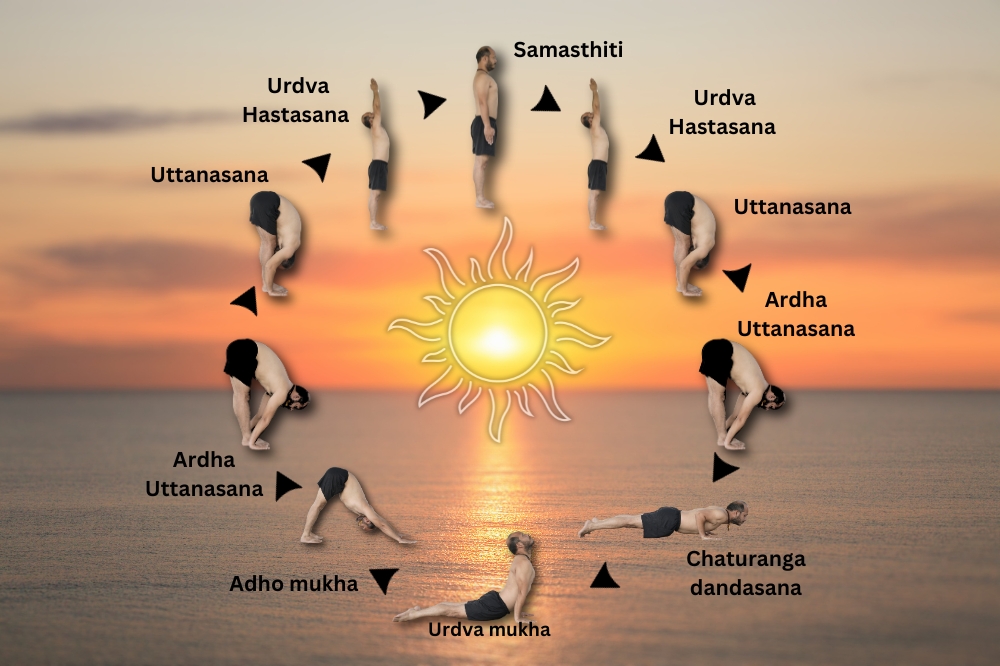
    Hatha Yoga - Surya Namaskar

    Sun salutations are the foundational sequences that can be performed first or at any time. These sequences link a series of several pictures together in a flowing movement that is synchronised by breath. They are perfect for a complete body workout and can be practiced at various speeds depending on the exercise level of the individual or person doing it.

    These are the beginning yoga poses in Hatha yoga, but as you progress in your practice, you will get to explore a wide range of asanas that will further enhance your flexibility and practice.

    Pranayama (Breathing Techniques): The Power of the Breath

    Hatha Yoga - Pranayama

    Breath plays a vital role in yoga practice, as it is considered the life force. When you understand the connection our body has between the breath and the movements we do, it allows you to control your body’s energy (prana) and enhance and improve your overall practice.

    Simple breathing exercises:

    Ujjayi (Victorious Breath):

    In this breathing technique, you need to constrict your throat slightly while inhaling and exhaling, creating a soft, hissing sound. This breathing technique focuses mainly on the mind and helps in energising the body.

    Dirga Swasam (Three-Part Breath):

    As stated by the name, you are required to divide your breath into three parts. First you will fill your lower belly, then you will move to the mid-ribs and, in the end, the upper chest. And then you will have to exhale in the reversing sequence. The breath brings peace and promotes overall relaxation by calming your nervous system.

    Benefits of Mindful Breathing:

    Mindful breathing techniques help you build focus and create a sense of inner peace and well-being. When you focus solely on your breathing, it helps in distracting your mind and reducing stress while improving overall concentration and boosting the sense of calmness within.

    Getting Started with Hatha Yoga: The Essentials You Need

    We have already discussed the asanas and postures and what you will learn. But still, there might be many questions coming into your mind about beginning the class. This section will give you the knowledge to navigate your first class and make you feel comfortable while stepping onto your yoga mat.

    A Breakdown of the Class Structure:

    Every Hatha yoga class follows a well-defined set of structures that allow you to form practice and ease into the practice with rhythm. Here is what you can expect:

    • Warm-up (5–10 minutes): You will begin with some gentle movements and stretches to prepare your body for more activeness and asana practice.
    • Asana Practice (30–45 minutes): This is the essential part of the class, where you will flow both physically and mentally through a sequence of postures that are designed specifically to improve overall bodily strength, flexibility, and balance.
    • Cool-down (5–10 minutes): After some heavy movements, you will go through some calming stretches and postures to help your body get calm and transition from exertion to relaxation.
    • Relaxation (5–10 minutes): The class will end with a relaxation pose like Savasana (corpse pose), which is the final stage that allows your body and mind to completely relax and integrate the practice.

    Respecting Etiquette:

    Respect and mindfulness are essential elements to keep in mind while practicing yoga. Here are some helpful points to remember in order to maintain an inclusive and positive environment in the classroom:

    • Arrive early: Punctuality is the key; try to arrive a few minutes early for the class. This will allow you adequate time to settle in, resolve your query, and find a comfortable spot.
    • Maintain personal space: While keeping a focus on your practice, do not forget to be aware of your fellow yogis too. Maintain a respectful distance between the mats for better focus.

    Choosing Your Perfect Class:

    For individuals with different levels, there are a variety of Hatha yoga class types, each catering to the specific needs of individuals. Here is how you can find the right fit for you:

    • Beginner Hatha: These classes are designed for newcomers and teach you the fundamental postures of Hatha Yoga with clear instructions and modifications for beginners.
    • Gentle Hatha: These classes are beneficial for those individuals who are going slow in their practice with some limitations, as these classes focus on relaxation and general stretches only.
    • Restorative Hatha: These classes utilise props for support and include advanced postures for passive stretching and deep relaxation.

    Finding a Qualified Instructor:

    A supportive and qualified instructor plays a vital role in guiding you safely and effectively in your yoga journey. It is essential to look for someone with years of experience in teaching Hatha Yoga.

    Also, look for a yoga school that is registered with the Yoga Alliance and has a good reputation for teaching and conducting classes, such as Bali Yogshala

    Preparing for Your First Class:

    Don’t be nervous; just be mentally prepared, and it can ease your first-class jitters. Here’s what you can pack and bring to the class:

    • Comfortable Clothing: Wear loose clothes that allow you to move freely. You can also go for natural fabrics like cotton.
    • Yoga Mat: A yoga mat is a one-time investment, so get one that provides ample support and cushioning.

    Conclusion:

    As you begin your journey with the practice of Hatha yoga, remember the array of benefits it offers. Do not forget to maintain a regular practice, as it is the key to a flexible and strong body with improved balance. But apart from its physical aspects, it can also be a powerful tool for various mental issues, which include stress management, inner peace, and relaxation. The mindful breathing techniques this yoga offers will not only benefit you during the class but can also help you become calmer and more focused in your everyday life.

    The wait is over. Just pack your bag, get your mat, and begin learning Hatha yoga now. There are countless resources available to you to support you on your journey. Many reputable yoga studios, such as Bali Yogshala, offer introductory classes to provide you with a wealth of information and proper guidance and inspiration. So take the first step and begin your practice while discouraging the immense benefits of this beautiful practice.

    Get in Touch:
    Best Yoga Teacher Training In Bali | 100 Hour Yoga Teacher Training In Bali | 200 Hour Yoga Teacher Training In Bali

  • 6 Yoga Poses for Better Sleep: Simple Techniques for Relaxation

    6 Yoga Poses for Better Sleep: Simple Techniques for Relaxation

    Getting a nice sleep feels like an achievement now. After a tiring and hectic day, good sleep is something we crave. But many of us fail to achieve this, and even counting the sleep all night doesn’t work better, resulting in a frustrated mood the whole day. Sleep issues are common nowadays and affect millions of people every day, hampering their everyday duties and tasks. Incorporating yoga poses into your routine can help address these sleep issues and promote better rest.

    While some may prefer the use of medicines, we will recommend going for better and healthier options. While yoga is a great option to boost your physical health, it is also one of the best alternatives to improve your overall sleep as well. Yoga is an ancient practice that goes beyond just some physical postures. It is an inclusive practice that requires the involvement of both mind and body and combines breathwork, gentle movements, and meditation to promote overall well-being and relaxation.

    Incorporating yoga into your daily routine comes with a multitude of benefits that result in better sleep at night. Adding yoga poses to your evening routine can enhance these benefits, leading to a more restful night’s sleep.

    Yoga Poses for Better Sleep

    Reduced Stress:

    One of the major issues behind less and disturbed sleep is stress. Practicing yoga posture daily helps in calming the nervous system down, quitting the mind and thoughts that bring peace to the mind, and preparing your body for a restful sleep.

    Improved Relaxation:

    Tiredness is also a reason for a lack of sleep. Sometimes we get so tired that it tenses the muscles in our body, preventing us from sleeping properly. Yoga, on the other hand, promotes muscle relaxation and helps release the tension that keeps us awake.

    Enhanced Body Awareness:

    Yoga is a master technique. If we talk about self-learning, it teaches us to be present in the moment and pay more attention to what our body is communicating to us. That helps you identify the root cause behind lack of sleep and address it on time for better results.

    Better sleep quality:

    By being relaxed and tension-free, practicing yoga can lead to a more enhanced and better sleep for the night and allow you to recharge completely.

    So, it’s time to stop being frustrated about the sleep hassle, ditch the sheep counts, and roll on your mat.

    The Power of Yoga Poses for Sleep: Know Its Effect on Your Mind and Body

    We have discussed earlier how yoga helps us get better sleep, but there might be a question buzzing through your mind: how does it work, and why do you feel so relaxed and calm after a session of yoga poses? Well, far beyond just physical vulnerability, this practice creates a calming wind-down routine and influences various things in our body that result in better sleep.

    The Nervous System Symphony:

    As we all know, our nervous system works like a conductor in our body that directs all of its functions. When we are stressed about something, it overdrives our nervous system and keeps us in alert and active mode, preventing us from sleeping.

    While yoga poses focus on gentle movements in our body combined with mindful breathing, they directly activate the parasympathetic nervous system (responsible for rest and relaxation). Doing so lowers our blood pressure, stabilizes the heart rate, and promotes calmness, which is perfect for taking us to a good sleep.

    Stress Less, Sleep More:

    Continually thinking about something and stressing over it is what mostly prevents us from having a good sleep; it keeps our minds in a buzzing mode, making it difficult to switch off and relax.

    Yoga poses, on the other hand, include meditation and breathwork techniques that help release the built-up tension and stop the chatter in the mind. When you focus on your breath, their rhythm, and the present moment, you can train your mind to ditch the stress and let go of anxieties while preparing you for restful sleep.

    The Power of Routine:

    Routine is something that can change a lot of things in our lives and is also a crucial part of good sleep hygiene. And before hitting the bed, incorporating yoga poses into your evening routine can be a good way to relax and calm your mind.

    You can include a gentle yoga session in the evening, as it will signal your body with calmness and convey the message that now it’s time to transition into sleep mode. This will not only help you get better sleep but will also regulate your sleep-wake cycle, making it easier for you to wake up and fall asleep.

    Yoga Poses for a Restful Night: Gentle Stretches for Deep Relaxation

    We have discussed that yoga is a helpful tool for better sleep. Now here are the specific poses and asanas that you can practice:

    Gentle Forward Bends: Soothing the Mind and Body

    Uttanasana (Standing Forward Fold Yoga Pose):

    Instructions:

    • Stand tall and keep your hips wide apart.
    • Fold forward by hinging on your hips.
    • Lengthen your spine and try to reach the ground with your hands.
    • Go slow and focus on your breath as you bend.

    Modifications for Beginners:

    • For tight hamstrings, you can bend your knees slightly.
    • Keep your knees bent as much as you need.
    • You can also place your hand on a block or a chair for additional support.

    Benefits:

    • It helps in calming the mind and promoting relaxation.
    • Releases the tension in the back and shoulders.

    Paschimottanasana (Seated Forward Fold Yoga Pose):

    Instructions:

    • Sit on the floor and extend your legs in front of you.
    • Hinge on your hips, avoid bending from the back, and reach forward.
    • Aim to touch your toes with your hands.
    • Lengthen your spine and focus on breathing.
    • Avoid rounding the back while reaching the toes.

    Modifications for Beginners:

    • Bend your knees if required for a smooth bend.
    • Place your hands on your shins or calves if reaching your toes seems far away.

    Benefits:

    • Relieve the lower back pain by stretching the hamstrings.
    • Promotes relaxation with breathwork control.

    Restorative Poses: Melting Away Tension

    Balasana (Child’s Pose):

    Instructions:

    • Kneel on the floor and keep your toes together.
    • Keep your knees hip-width apart.
    • Sit back on your heels gently while resting your forehead on the floor.
    • Extend your arms over your head and let them rest alongside your body.
    • Focus on your breath.

    Modifications for comfort:

    • For additional support, you can place a blanket or a pillow under your thighs.
    • Place a cushion under your head for better relaxation.

    Benefits:

    • It relaxes the body and mind deeply.
    • Provides emotional release.
    • Promotes gentle stretching of the back and hips.

    Viparita Karani (Legs-Up-the-Wall Pose):

    Instructions:

    • Lie on your back and relax your body.
    • Extend your legs straight up to the wall.
    • Rest your arms alongside your body.
    • Keep your palms facing up.

    Modifications for Using Pillows or Bolster:

    • Keep your hips scooted closer to the wall if needed.
    • Place a cushion or blanket under your lower back for additional support.

    Benefits:

    • Improves blood circulation in the body.
    • Reduces the tension in the lower back and legs.
    • Promotes calmness in the mind.

    Calming Twists: Unwinding the Spine

    Marjariasana-Savasana (Cat-Cow Flow with Corpse yPose):

    Instructions:

    • Begin by keeping your hands shoulder-width apart and your knees hip-width apart.
    • Keep both your hands and knees on the floor while resting your body on them.
    • Inhale and arch your back.
    • Lift your head and look up in a cow pose.
    • Exhale while rounding your back.
    • Tuck your chin to your chest in a cat pose.
    • Repeat this flow and transition to Savasana.
    • Lay flat on your back and close your eyes.
    • Keep your arms at rest on your sides.

    Modifications for comfort

    • Keep your movements slow and in harmony with your breathing.
    • Limit your range of motion.

    Benefits:

    • It helps with gently stretching the back.
    • Mobilizes the spine.
    • Promotes relaxation through mindful breathing.

    Supta Matsyendrasana (Supine Twist):

    Instructions:

    • Lie down on your back on the floor.
    • Extend your arms and create a T position with your body.
    • Bend your right knee and bring it across your body.
    • Place your right foot flat on the floor, outside your left hip.
    • Keep your left hand on your right knee.
    • Gently turn your head to look to your left.
    • Hold a few breaths and repeat the pose on the other side.

    Modifications for Comfort and Proper Alignment:

    • Keep your movements slow for better alignment.
    • Use a strap to gently pull your thighs to the floor.

    Benefits:

    • It helps in releasing tension in the ship and spine.
    • Improves overall body flexibility.
    • Promotes relaxation in the mind.

    Crafting a Relaxing Routine for Sleep

    Now that you know which yoga pose to do to get better sleep, let’s have a bedtime routine tailored specifically for you:

    Setting the Stage for Sleep:

    • Lighting plays a vital role; opt for dim and warm lighting for your room.
    • Ditch the bright bulbs and harsh lightning that can suffocate your sleep.
    • Create a cozy atmosphere to make you fall asleep faster.
    • Keep your room’s temperature in check for better comfort.
    • Adjust the temperature and put on some light pajamas to ensure comfortability.
    • Take help from gentle music and calming melodies before bed.
    • Opt for quiet music and experiment with what works best for you.

     Begin with breathwork and sequencing.

    • Breathing is the center of everything; begin with mindful breathing exercises.
    • Quit your mind with alternate nostril breathing or deep belly breathing.
    • For a shorter routine, focus on gently doing 2-3 poses, but do them regularly.
    • Prioritise comfort and proper alignment during the pose.
    • Avoid the rush of achieving perfection.
    • Don’t push yourself off the limits or into poses that can cause pain.
    • Focus on the breath and sensations of the body.

    Remember:

    Results can be better seen with consistency, as it is the key to everything. Aim to practice these poses every night before sleep to get optimal results. With dedication, you will be able to beat the stress and get better sleep.

    Conclusion: Sweet Dreams Await with Yoga

    Now, when someone wishes you to have sweet dreams, make sure you do have them by including these simple poses and techniques in your routine. Yoga is an ancient practice with a multitude of benefits, of which improving the overall sleep cycle is one. There is much more to explore about yoga, which you can also do by incorporating yourself into one of the great programmes of YTTC.

    However, when coming back to seep issues, include this practice and wait for at least a few weeks to see the best results. But if you continue to experience persistent sleep issues, then we will advise you to seek professional help. There might be a chance that there is an underlying issue that is affecting your sleep, and they will recommend additional treatment options accordingly.

    So it’s time to dim your light and create a cosy atmosphere, but no, no, let’s not go to sleep before the practice. Roll your mat and let these easy yoga poses guide you through a blissful sleep that has sweet dreams.

    Get in Touch:
    Best Yoga Teacher Training In Bali | 100 Hour Yoga Teacher Training In Bali | 200 Hour Yoga Teacher Training In Bali

  • Experience the Essence of Bali: Yoga Teacher Training with Luxury Accommodation and Cultural Immersions

    Experience the Essence of Bali: Yoga Teacher Training with Luxury Accommodation and Cultural Immersions

    While practicing yoga, how do you feel about the weather? Which weather and what type of ambiance suit you more? Well, when we talk about the perfect environment for practicing yoga, we imagine ourselves surrounded by emerald rice paddles with a gentle smell of frangipani flowers in the air. Along with this, the rhyming sounds of ocean waves offer the perfect background music for the class. Sounds amazing, right? That’s exactly what you get in Bali, which is also referred to as the Island of Gods.

    For centuries now, Bali has been the go-to destination for yoga practitioners who look for a place to not only deepen their yoga practice but also connect them with their own selves and this holistic discipline. And Bali Yogshala, which is situated in the heart of this island, provides you with the opportunity to begin your yoga journey and make a change in your daily lifestyle and yourself.

    Our exclusive range of teacher training programmes in Bali offers a combination of various activities, including intensive yoga training, great cultural experiences, and luxurious accommodations, all in a package that suits you well. Our programmes are designed to offer you complete relaxation during your stay while letting you discover the rich culture of this island.

    Intensify your yoga practice in the heart of Bali

    Yoga teacher training programmes in Bali are designed in a way to take you on a journey where you can learn, explore, understand, and experience the various aspects of yoga. Here’s what you can expect from these programmes:

    Structured Learning:

    There are different teacher training programmes that we offer in Bali that span 100 hours, 200 hours, and 300 hours, respectively. Based on your choice of YTTC, we offer you the learning of yoga to build the foundation of your practice, along with the principles of philosophy, alignment principles, anatomy, and teaching methodology.

    Diverse Yoga Styles:

    Here, you can explore the various styles of yoga, from Hatha to Vinyasa to Yin. This way, you can choose the one yoga practice that resonates best with you and that you desire to master in order to become a skilled yoga teacher (if this is your goal). This also helps you gain the versatility through which you will be able to cater to the needs of various students in the future during the class.

    Experienced Guidance:

    Learning from people who have experience is what makes this more special, and they not only teach you through theoretical knowledge but also add up their own experience in teaching to make it even more realistic and beneficial for you. At Bali Yogshala, we have skilled yoga gurus who not only have mastered their craft but also have a deep understanding and knowledge of the rich history and philosophy of yoga.

    Traditional Roots:

    Yoga teacher training programmes in Bali go beyond just physical yoga practice and take you to the traditional philosophy. This will help you understand better the hows and whats of this practice. You will also explore the eight limbs of Ashtanga yoga and know the connection between the body, mind, and soul.

    Refine in Serenity:

    These programmes let you practice in a stunning and calm environment. You can begin your day with flowing sun salutations in open air with the relaxing sound of waves and lush rice paddy fields alongside. The beauty and serenity of Bali are perfect to not only amplify your practice but also to have a deep connection within.

    Luxurious Comfort: Elevate Your Yoga Experience in Bali

    Comfort is something that attracts us and motivates us to stay somewhere, and that’s exactly what we offer in Bali. We offer a comfortable stay with a touch of luxury to nurture your well-being and make your visit to Bali memorable.

    Indulge in unparalleled comfort:

    After a hectic day filled with intense practice and various activities, you must be drolling to unwind and relax in privacy. At Bali Yogshala, we offer both shared and private rooms with attached spacious bathrooms with showers to help you melt away all the lingering tension from your body and mind and give you time and space to gain your energy back.

    Private Oasis for Relaxation:

    Most of our rooms feature private balconies and open terraces, where you can relax in private, enjoy your me-time, or connect with nature and practice mindfulness. You can also picture yourself sipping your herbal tea in the morning, experiencing the warm sunshine from your room, or meditating in the gentle sounds of the tropical landscape of the island.

    Luxury: A Catalyst for Transformation

    Luxury is not a necessity but is an additional support for our yoga journey that makes it more relaxing. A good night’s sleep in a comfortable bed allows individuals to approach each day with new energy and focus.

    Additionally, spacious areas are perfect to create a space for group discussions and to build the connection between all individuals in a class. Ultimately, it just enhances your overall living experience and helps you get yourself ahead in your practice with improved focus and an energised body.

    Know About Balinese Culture: A Journey Beyond the Asana

    Our YTTC is not only about yoga and practice, but it goes beyond that, even far beyond the mat. Yes, you can learn about the rich culture of Bali and explore this place on your own to understand its rich history and create memories that last a lifetime.

    Unveil the sacred:

    The evenings of each day of our programmes are reserved for guided visits to various magnificent temples on this island, where you can learn about the spiritual lifeblood of Bali. You can learn about the traditional ceremonies and also learn about the Hinduism culture in Bali and the significance of offerings.

    Witness the Art of Movement:

    Balinese dance is a fun activity to explore. You can attend live performances of the Kecak dance, which is famous due to its energetic chanting, or the graceful Legong dance. Getting yourself to the different culture not only helps you build a connection but also provides you with a visual feast and a connection between the expression, body movements, and storytelling they have through their dance form.

    Embrace the creative spirit.

    Do you love art? Then this place is perfect for you, as you can enroll in different art and craft workshops in Bali. You can know and learn the art of Bati creation, weaving techniques, or wood carving that are used to craft traditional offerings. These workshops are an excellent opportunity to get hands-on experience in these practices.

    A Transformational Journey: More Than Just Yoga Teacher Training

    Our YTT programmes are more than just a way to get your professional certification as a teacher; they are a journey and not a destination that takes you somewhere deeper in understanding and practice to transform you as a person.

    Evolve as a Yoga Practitioner:

    If you are a beginner or a yoga practitioner, our YTTC programmes help you refine your yoga practice. Through intensive training, various classes, and personalised guidance, you can learn in depth about the yoga philosophy and develop the major skills you need as a teacher to confidently guide others in their journey too.

    Embrace Self-Discovery:

    Yoga is not about the physical practice alone, and as you go much deeper in this practice on a level to help you teach others too, you get to walk on a path that takes you to self-discovery. These programmes create a space for reflection and allow you to fully know your inner self and become aware of your potential.

    Cultivate Mindfulness:

    Yoga is a mindful practice, and when we combine it with the serene culture and calm environment of Bali, it fosters a deep sense of mindfulness within. This will help you cultivate present-moment awareness and manage your stress effectively. You will also be able to approach life with better clarity and a greater purpose.

    Find Inner Peace:

    Peace of mind is a necessity in our lives, as it is the only approach that leads to everything, and through the programme, you will be guided towards achieving it. Practices like pranayama and meditation techniques are great for managing your emotions, radiating peace, and achieving calmness in all aspects of your life.

    More than a certification:

    In this expansive world, these programmes are a small investment in our overall well-being. After a successful completion of a course, you will receive a yoga certification, but is that it? No, what you will have is a transformative perspective and a new self that knows more and will resonate throughout your life.

    Conclusion: What You Can Have in the Paradise of Bali

    We have explored and let you experience the immense benefits this beautiful place has to offer. Now you can imagine yourself returning from our Bali Yogshala’s teacher training programs, not only as a skilled teacher who is ready to begin his journey as a teacher but as a transformed individual.

    You will have a deepened practice under the strict guidance of our skilled yoga teachers and will master diverse styles while gaining an understanding of yoga philosophy. Additionally, the luxurious accommodations at our school will provide you with a haven for relaxation and privacy.

    But apart from all of these, the true experience and memories lie in the immersive cultural experience you will have on this island. When you explore the ancient temples, witness the different dance performances, and engage yourself with local communities, you will appreciate the root of yoga and the deep connection it has with Balinese life.

    After all, if we conclude about the teacher training programmes in Bali that we offer in our school, Bali Yogshala, then it is more than just a teacher training programme, but a life-changing journey that will leave you transformed forever. So what are you still waiting for? Are you ready to be transformed, both physically and mentally? Then don’t just hold on. Visit our website today, choose the YTTC programme that best suits you, and take the first step towards your goal.

    Get in Touch:
    Best Yoga Teacher Training In Bali | 100 Hour Yoga Teacher Training In Bali | 200 Hour Yoga Teacher Training In Bali

  • Surya Namaskar: A Beginner’s Guide to Sun Salutations

    Surya Namaskar: A Beginner’s Guide to Sun Salutations

    The sun salutation, also known as Surya Namaskar in Sanskrit, is a sequence of yoga poses, as determined by the name, practiced in the morning with a sun rise that links the body movement with breath. It is one of the most beautiful and best ways to warm up your body before any class while building strength and improving flexibility for better alignment. Usually, this practice is often used in the morning or before any yoga class, but you can practice it anytime as a full-body workout.

    But even if you are a beginner or a practiced yogi, practicing this requires a series of steps to be followed with focus so that you can easily enjoy the benefits of these sun salutations. In this guide, we will get you through all the poses step by step with modifications. So let’s get into the learning without wasting a second, with the multitude of benefits it offers for both body and mind.

    Benefits of Sun Salutations

    Warm-up for the body:

    Sun salutations are a great way to warm up and prepare your body for the day’s practice, yoga classes, and any physical activity. They help in moving all the muscle groups in your body gently while increasing the blood flow and loosening up all the tight areas for better practice.

    Improves flexibility and strength:

    Various poses aligned in sun salutation are usually related to stretching, which also strengthens different muscle groups throughout the body. So if you practice these poses daily, it can eventually result in improved flexibility and build up strength in the back, arms, legs, and core.

    Increases circulation:

    Practicing these salutations requires body strength, and as with any other practice, it gets your heart rate up, resulting in improved circulation throughout the body. This practice helps deliver the major nutrients and oxygen to the cells more efficiently and removes waste products from the body.

    Promotes mindfulness:

    Practicing these salutations requires focus on your breath and movements, which lead to a quiet mind and promote mindfulness. Through this, you can better start your day in a great way or de-stress your mind after a hectic day.

    Before you begin: Be Prepared

    Before you begin your movements, preparing for them is essential for an enhanced practice. While not necessary, having a yoga mat will help you with better grip and cushioning for your practice. Additionally, having comfortable clothes on will allow for better and easier movements.

    Breathe Easy:

    Sun salutations are all about synchronising your breath with your body movements, so here’s a quick tip:

    • Inhale: Fill your belly with air and breathe in through your nose as you expand your body or lengthen it (while keeping your arms up or getting back into the plank).
    • Exhale: Release all your tension as you exhale through your nose or mouth while you fold or contract your body. (Usually during a forward fold or downward-facing dog.).

    Keeping your focus on these breathing techniques will help you move your body with flexibility and fluidity while connecting it with your mind throughout the sequences.

    The Sun Salutation Sequence: Step-by-Step 

    The sun salutation sequences are a flowing series of twelve poses that are linked together with each other with breath. Let’s get to it:

    1. Mountain Pose (Tadasana):

    How to do:

    • This pose begins with standing tall with your feet.
    • Keep your hip width apart from the feet, and evenly distribute the body weight to all four corners of your feet.
    • Draw your navel in slightly while engaging your core. 
    • Stack your shoulders over your hips directly.
    • Lift your head crown and lengthen your neck.
    • Breath in and out, both deeply and evenly.

    Benefits:

    • It helps improve posture.
    • Reduce hip and back pain.
    • Strengthens core and leg muscles.
    • Regulate digestion and respiration.
    • And promotes a sense of grounding.

    2. Raised Arms Pose (Urdhva Hastasana):

    How to do:

    • Take a deep breath, inhale, and raise your arms overheated.
    • Join your hands in prayer form, reaching through your fingertips.
    • Keep your shoulder blades down and back, to your flexibility level.
    • Keep your gaze softly upwards.

    Benefits:

    • It opens the chest.
    • Increases the flexibility
    • Strengthens shoulders and arms
    • Give strength to the back muscles by lengthening the front.
    • Energises the body.

    3. Forward Fold (Uttanasana):

    How to do:

    • Inhale and hinge at your hips.
    • Fold your sleeves forward.
    • Bring your hands on top of or alongside your feet.
    • Give length to your spine as per your flexibility.
    • Relax your neck and head.
    • Let your head hang heavy for a while.

    Benefits:

    • It aids digestion.
    • It stretches the hamstrings and calves.
    • Ease, stress, tension, and fatigue.
    • Improves circulation in the body and muscles.
    • It calms the mind.

    4. Halfway Lift (Ardha Uttanasana):

    How to do:

    • Inhale and lengthen your spine.
    • Stretch your hands straight.
    • Reach to your shins or the floor.
    • Keep your face forward and bend your knee if required.

    Benefits:

    • It helps in maintaining a healthy curvature of the spine.
    • It strengthens the core and back muscles.
    • It helps prepare the body for bending postures.
    • It stretches the hamstrings.
    • Improves spinal flexibility.

    5. Plank Pose (Phalakasana):

    How to do:

    • Exhale and lower yourself to a plank position.
    • From head to heels, keep your body in a straight line and your core engaged.
    • Put your weight equally on your legs and hands. 
    • Gaze down between your hands and mind your breathing.

    Benefits:

    • Improve the posture and body balance.
    • Strengthens the core, shoulders, arms, and wrists
    • improves body flexibility.
    • Builds overall stability.
    • Removes backache.

    6. Low Plank/Knee-Chest Pose (Chaturanga Dandasana):

    How to do:

    • If you find the Plank pose challenging,
    • In this pose, you can lower your body to the mat instead of keeping it in a straight line.
    • Keep your core engaged.
    • Lengthen the spine.

    Benefits:

    • Strengthen and tone the abdominal region.
    • Relieve lower back pain.
    • Strengthen the muscles and body.
    • Provides stability.

    7. Upward-Facing Dog (Urdhva Mukha Svanasana):

    How to do:

    • Inhale and push yourself up off the mat.
    • Put your body up in an upward-facing dog pose.
    • Begin by arching your back.
    • Slowly press your chest forward.
    • Loog upward and lengthen your neck as much as possible.
    • Keep your legs strong and your core engaged.

    Benefits:

    • It stretches the body and intercostal muscles.
    • It strengthens the back, shoulders, arms, and core.
    • It helps counteract regular forward flexion activities.
    • Open the chest.
    • Improves flexibility in the spine.

    8. Downward-Facing Dog (Adho Mukha Svanasana):

    How to do:

    • Exhale and push your hips back and up (opposite of the previous pose).
    • Put your body in a downward-facing dog pose.
    • Create an inverted V shape with your body.
    • Press your heels and body on the mat to achieve the pose as closely as possible.
    • Push your chest forward and lengthen your spine.
    • Keep and maintain your gaze between your legs.

    Benefits:

    • It elongates the spine.
    • It stretches the hamstrings, calves, and shoulders.
    • It helps relieve tension and stress.
    • Strengthens the core and arms,
    • Improves circulation in the body.

    9. High Lunge (Ashwa Sanchalanasana):

    How to do:

    • Inhale and step one foot back between your hands.
    • Keep your knees to the floor and bend at a 90-degree angle.
    • Keep and maintain your hips squared and forward.
    • Keep your gaze forward and slightly upward.

    Benefits:

    • Bring stability to the body.
    • It stretches the hip flexors, quadriceps, and groyne.
    • It helps in improving joint function.
    • Strengthens the legs and core,
    • Improves balance.

    10. Halfway Lift (Ardha Uttanasana): Repeat from the other leg:

    This pose is the same as the halfway lift pose but can be done with the other leg by stepping it back between the hands. (Read number 4 pose instructions.).

    11. Forward Fold (Uttanasana): Repeat the Forward Fold:

    This pose is a replica of the forward-fold pose and can be done from a new standing position. (Read number 3 pose instructions.).

    12. Raised Arms Pose (Urdhva Hastasana): Repeat Reaching Arms Up:

    For this pose, you need to repeat the raised arm pose by keeping your arms overhead and inhaling (read number 2 pose instructions).

    13. Mountain Pose (Tadasana): Return to Starting Position:

    Exhale and return to the beginning, where we started from the mountain pose (number 1).

    This completes one round of sun salutations. You can repeat the poses with the other side as well and include this in your regular practice for improvement and warming up.

    Sun Salutations Made Easy: Modifications for New Yogis

    Sun salutations are beneficial for individuals of all levels and can be adapted by anyone. But if you are new to this practice, here are some tips to help you with better awareness and practice:

    Focus on form over perfection.

    We can achieve perfection with great practice, so it’s better to first focus on the alignment of the body correctly in each pose. It’s better to go slow and steady and adapt accordingly than push yourself and your body beyond their limits.

    Bend your knees.

    All the sequences usually require a straightened body and knees, so it is completely okay to bend your knees as many times as needed throughout the sequence practice. Poses like plank pose and downward-facing dog pose require a lot of strength, so keep your body energy neutral and bend as needed if required to maintain a proper form and protect your joints from any injury or pain.

    Utilise props

    Rather than trying one thing 100 times, try using props such as yoga blocks, which can be a great tool for all beginners. You can use them for elevating your hands for sequences like forward folds or to support you under your knees in plank pose.

    Listen to your body

    One of the most essential pieces of advice that we can give to you all reading this out there is that you should and must pay attention to the signals your body gives you. Take proper breaks whenever needed, and go slow and steady as per your convenience and health.

    Utilising and following these tips and modifications will let you enjoy the immense benefits of sun salutations at their maximum, regardless of what experience level you have.

    Conclusion

    Sun salutations are a great and fantastic way to warm up your body and begin your day. It is also effective in energising the body and relaxing it after a long day. By including this beneficial practice into your daily routine, even if you practice it a few times a week, you can experience the array of benefits it has to offer to your body, mind, and soul.

    So even though you are a beginner, don’t wait any longer; roll down your mat, and if not, you can just begin with a clean floor and give these sequences a try on your own. Be ready to be shocked and surprised by the quick benefits you will get to see in a few weeks. Make them a part of your well-being journey and guarantee the health check ahead.

    Get in Touch:
    Best Yoga Teacher Training In Bali | 100 Hour Yoga Teacher Training In Bali | 200 Hour Yoga Teacher Training In Bali