Tag: hatha yoga

  • Your Complete Guide to Hatha Yoga & Five Foundational Poses

    Your Complete Guide to Hatha Yoga & Five Foundational Poses

    Sometimes, your mind goes like a train without a driver. Yes, I, too, have gone that way. It is the coming of a gentle pause in our hectic life. It is keeping the balance, anchoring oneself to the self. “Ha” (sun) and “Tha” (moon) represent such harmony, a dance between the active and the calm.

    It is an ancient practice, best served to address the disorder of our modern times. At Baliyogshala, it is believed to kindle the spirit over the flashlights within. Our Hatha Yoga classes will be a safe cocoon for everybody who walks in, regardless of experience. We see it as something beyond exercise; it is a journey of coming in touch with one’s body and mind so one can learn to navigate through life with ease and joy. Think of it as a gentle embrace of the soul getting you to the center.

    Part 1: The Physical Bloom (Asanas and the Body)

    And now let’s look at the physical aspect of Hatha Yoga, meaning the asanas, or poses. Now that you don’t fixate on either of the Instagram moldy yogis! Those are more than pretty shapes. They’re more like friendly conversations you’ve had with your body.

    Another way to look at it is that each pose represents that opportunity for you to find out how your body moves and where it holds tension and where it has strength. It’s the right alignment that you maintain in practice, making sure no part is pushing itself into the straining. The breath? It becomes your guide. You don’t just hold the position; you move through with your breath into the rhythm.

    And besides that, these poses do wonders for your body. Say no more. It isn’t just stretching; you are toning your muscles, improving blood circulation, and inducing a fall into your nervous system. For example, ‘Dog position’ acts in stretching the hamstrings and toning the arms while slightly improving the blood circulation into the brain.

    Right now, I know some folks believe yoga is just for super-flexible people, but that’s a myth! Hatha yoga is for everyone. You don’t have to touch your toes. Yoga is meeting your body wherever it is today. Honestly, it’s all about progress, not about being perfect. And if you’re a little stiff or tight, then that’s okay! That’s what this practice is for. We are all on our different journeys.

    Part 2: The Voice of the Breath (Pranayama and Energy)

    Now, we talked about the poses, but really, it is the breath where Hatha Yoga comes alive. This is not about just breathing; it is about how to breathe. Your breathing is your life energy, or as they say in yoga, ‘Prana.’ It is what keeps you going. Learn more about Breathwork for stress relief .

    Now, ‘Pranayama’ is quite a fancy term simply for controlling the breath. And believe me, it is far more potent than it sounds. When you start to notice the breath, you start noticing what it does to you. In other words, have you ever noticed when you are stressed, your breath gets shallow and fast? Well, pranayama teaches you the ‘how-to’ to slow that down and take calm breaths.

    Here is the thing: that breath will very well directly impact your nervous system. And once you are able to control the breath, you calm the restless mind within. It is like resetting. Again, you don’t have to be a yoga master to do this—the level of your mastery doesn’t matter. A couple of minutes focused on simple breath awareness can make wonders happen.

    Right now, inhale deeply through your nose, feeling your belly rise, and breathe out slowly. Be aware of how you feel. A little deep breathing has already provided for better calmness.

    During the class, we practice many techniques of breathing, and you will learn how to use them to calm or quiet your mind. Breath is important, and we all do it, yet so few of us do it right!

    Part 3: The Mind’s Stillness (Meditation and Mindfulness)

    So, I am not going to deny that our physical practice, breathing, has made our bodies cool, but our mind is the busiest place I have ever visited. And being a fact, this is where Hatha Yoga has its upper hand. It is not just sticking to the asanas; it goes further into making one’s mind more calm.

    Hatha Yoga is all about practicing one’s whole being. It involves not only mind, body, and spirit but also mindfulness and meditation. Now don’t be intimidated by that word. Mindfulness is simply being in the present moment and noticing what is currently going on without a bit of judgment. And as for meditation? It is almost like giving one’s mind a vacation.

    Think of it this way: Our minds are like radios blasting always, where quite a few are just static. Meditation helps you tune it down, so to speak, to find a quiet station. In this way, one becomes much clearer and calmer. It is like moving away from the cobwebs, you know?

    I really do think the pedestal-style way of meditating isn’t for me. I would much rather give a few minutes to visualizing my breath. What I do is sit down comfortably in a quiet place, close my eyes, and come in resonance with my breathing activity. If anything invades my space of focus (and trust me, it will), I simply just observe my mind wandering away, and I bring it back to where it should be: my breath. It’s as easy and simple as that. Seriously, it’s a lifesaver. I have other ways to meditate in class, and you will find those that will suit you best.

    The Core: Five Foundational Hatha Yoga Poses

    The really good part comes now—its poses! These five stand as building blocks of Hatha Yoga. They’re a bit easy but forceful and give a solid and strong foundation.

    A. Mountain Pose (Tadasana): The Base of The Stable Heaven:

    What is the purpose of the Mountain Pose in yoga?

    It begins with Mountain Pose. Sounds easy, huh? But internally it calls for committing and grounding oneself. Stand erect, feet hip-width apart, and envision that from your feet are growing roots to the floor. Feel the elongation of the spine and relaxing of the shoulders. It’s steadiness and feeling strong. This is a very nice posture for starting your practice or even when you need to center yourself.

    B. Tree Pose (Vrksasana): Equilibrium of Inner Self:

    How to do Tree Pose vrksasana?

    Let’s try Tree Pose now. Shift weight on one foot and bring the other foot’s sole on the thigh or calf above the knee! Pick a focus point and stabilize the balance. It’s really a mantra of finding inner stability and strength when things get a little bit wobbly. And really, if there were wobbly bits, so what! It’s all part of the progression.

    C. Warrior II Pose (Virabhadrasana II): Strength and Courage:

    What is Warrior 2 pose good for?

    Let’s get to the Warrior II now! Spread your feet wide apart; turn out one foot; with the knee of the front leg bent, lift your arms above you. Feel the strength in your legs, the openness in your chest. It’s finding that courageous, wild warrior inside of you. Also, a great pose for strengthening your legs and core.

    D. Downward-Facing Dog (Adho Mukha Svanasana): Rejuvenation and Renewal

    Adho Mukha Svanasana Yoga

    Downward Dog is a classic for a reason. From all fours, tuck your toes, lift your hips up, and back. Feel the deep stretch in the back of your legs and the lengthening of your spine. It is kind of like a mini-inversion, great at quieting the mind while refreshing the body. Anyhow, if your heels don’t touch the floor, not a big deal! Just focus on lengthening your spine.

    E. Child’s Pose (Balasana): Surrender and Rest

    Finally, let’s settle into Child’s Pose. Kneel with your big toes touching and sit back onto your heels. Fold forward, bringing your forehead to the mat. It is the pose of surrender—a chance to let go and relax. It is a perfect chance to rest or to find some stillness.

    Why these five?

    These five poses give you a good foundation. They work on strength, balance, flexibility, and grounding. These are the poses that you come back to in class again and again. You will see how they help you advance in your yoga practice.

    Part 4: The Benefits Unfold (The Ripple Effect)

    Okay, we covered the poses and the breath. But what’s in it for you, right? I’d say Hatha Yoga is one of the most remarkable bodies in history!

    A. Physical Well-being:

    You’re also going to find your flexibility improving. You’re actually going to start reaching and not worry about snapping in half. You’ll get stronger too—without bulking up. I mean, long, lean muscles. And it’s great for your joints. Injuries, aches, and pains—Hatha Yoga can help you relieve those aches. It’s good, of course, to get the heart working.

    B. Balance of the mind and emotions.

    But it’s not just about the body. You’ll probably find your mind feels a bit calmer too. Like, the constant chatter starts to quiet down. You’ll sleep better, feel less stressed, and just basically be more at peace. It’s like a mini-vacation for your brain. And you begin to know yourself a little better—how you react to things, how you feel.

    C. Connection to spirit.

    I know that ‘spiritual’ may sound kind of scary, but it really isn’t. It is more about connecting with oneself, inner peace, and a sense of ‘okay-ness.’ You will start feeling more grounded and present in your daily life. It’s like finding a little bit of magic in the everyday.

    D. Benefits for Students.

    Hatha yoga is especially helpful for students. It helps them with focus, concentration, and stress management, and a calmer mind helps to enhance learning and the absorption of information. It also releases pent-up energy from being in class all day. It promotes good posture, which also helps concentration 17 ways yoga actually improve over health by Science . We have seen some students improve their grades when they practice yoga regularly.

    Part5: Cultivating Community (The School’s Offering)

    You’ve heard about poses, breath, and benefits—above everything else; now try it out for yourself. We’d love to have you in our Hatha Yoga classes here at Baliyogshala!

    A. Join Our Hatha Yoga Classes:

    We have developed a friendly atmosphere wherein you can come just as you are. Our basic 100 hours yoga teacher training classes are for everyone—whether you are a complete beginner or you have been practicing for some time. Our instructors are most passionate and knowledgeable, here to help you here and there. They are here to help you achieve your personal best. You can find a class, any one of which ranges from gentle flows to more energizing classes, depending on what feels right for you.

    The community is one of the best aspects of classes. It is not only about doing the poses; it’s about connecting with people, sharing moments, and supporting one another. We believe in creating a safe and nonjudgmental space for you to explore your practice at your own pace. We’re all on the same journey, and it’s nice to walk with others. We want you to feel at home and supported, no matter how far you are into your yoga journey.

    So what are you waiting for? Come join us! Take that first step to a calmer, stronger, more balanced you. Join a class or just come by and say hello. We’d love to meet you. And don’t forget to follow us on social media for updates and inspiration. We share tips and information all the time. See you on the mat!

    Conclusion—Bringing it All Together

    And thus we are aware of the whole sphere of Hatha Yoga with all its grounding poses and calming aspects, breath, and tranquil states. And it really is more than an ensemble of exercises; it’s a journey—inside.

    A. The Journey Within:

    Hatha Yoga is a tool, an avenue through which anyone can connect deep within himself. It is a cohesion between the realms of strength and softness, activity and stillness. It is a process of learning to listen to one’s body, quieting the chamomile mind, and reaching that inner calm that has always waited for one inside. What’s cooler is that such a journey never ends. There’s always some more to learn; there’s always some space to grow; and there’s always something new in oneself to discover.

    B. A Last Word:

    Even if you’re one less-than-perfect, it’s important to remember to show up, be present, and take care of yourself. Just like yoga: not about touching your toes; it is about what you learn on the way down.’ So breathe, go easy on yourself, and embrace the journey.

    And remember, the peace you seek is already within you. Thank you for journeying with us.

    Join Our Yoga Courses : 100 Hour Yoga Teacher Training in Bali, 200 Hour Yoga Teacher Training in Bali, 5 Days Yoga Retreat in Bali

  • Unlock the Secrets of Hatha Yoga: A Positive Journey for Beginners

    Unlock the Secrets of Hatha Yoga: A Positive Journey for Beginners

    Yoga is an ancient and dynamic practice that has its roots in India, and among a wide range of different yoga styles, Hatha yoga is considered the beginning and foundation for modern yoga styles. The word hatha has a meaning infused, which translates as “ha” meaning sun and “tha” meaning moon in Sanskrit. It showcases and puts much value in the concept of balance, which represents using opposing energies within us in union.

    If you are a beginner and are exploring your way into yoga, then practicing Hatha yoga can bring you a number of great benefits. It includes a subtle mix of various asana practices and mindful breathing techniques (pranayamas), which not only improve your flexibility but also strengthen your body and enhance your overall well-being. While regular practice can help with a lot of things, including stress reduction and fostering inner peace,. 

    So if you are curious about how yoga can enhance and improve the quality of your life and how much potential it has for changing your life, then Hatha yoga is the perfect to begin the oracle.

    Hatha Yoga

    The Essentials of Hatha Yoga Practice

    Asanas (Postures): The Foundation of Movement

    Asanas, or the physical postures, are the core aspects of Hatha yoga, and in this section, we will discuss exploring and maintaining some fundamentals to have an effective and safe practice.

    Alignment and Breathwork: The Guiding Principles

    Before beginning any specific posture, you need to keep these two things in mind:

    Alignment:

    Proper alignment is the only way to save yourself from any injury or mishap during the practice. While ensuring safety, they also maximise the benefit of each pose. Choose a qualified and experienced yoga instructor, as it will be helpful to provide you with the correct guidance on optimal alignment for each asana.

    Breathwork (Pranayama):

    In yoga, breath is considered a powerful bridge between mind and body. When you coordinate your body movements with your breath, it brings focus and control to your practice. It’s best to focus on inhaling while you open your body and exhaling as you release the tension.

    Beginner-Friendly Asanas:

    Let’s take a quick note on some basic poses, categorized by how they function:

    Standing Poses (Balance and Strength):

    Tadasana (Mountain Pose):
    • Stand tall with your knees straight.
    • Keep your feet hip-width apart.
    • Ground through your soles.
    • Stretch your arms up and stand on your feet.
    • Come down, stand at your feet, and put our hands down. Repeat a few times.
    Vrikshasana (Tree Pose):
    • Stand straight and tall to balance your body on one leg.
    • Hold the other leg and place it on the inside of your thighs.
    • Join both your palms in a Namaste and bring it to your chest.
    • Hold the pose and breathe steadily.
    Benefits of Standing Poses
    • It helps reduce the overall body weight.
    • Strengthen the ankles, hips, and chest.
    • Improves digestion and concentration.
    • It calms the mind and releases stress.
    • Stretch the thigh muscles and abdominal organs.

    Forward Bends (Flexibility and Inner Peace):

    Balasana (Child’s Pose):
    • Kneel down on the floor.
    • Keep your feet placed on the mat.
    • Take a breath and spread your knees to the length of your hips.
    • Keep your shoulders on your knees.
    • Extend your hands straight upwards and rest them on the mat.
    Uttanasana (Standing Forward Fold):
    • Stand straight on your feet and keep your spine straight.
    • Balance your weight equally on both legs.
    • Keep your arms over your head and motion your breathing while inhaling.
    • Enhale, stretch your body, and hinge at the hips.
    • Bend forward completely with a flat back.
    • Fold your body down towards your feet.
    Benefits of forward-bending poses:
    • Strengthen the thighs, knees, and legs.
    • It helps reduce tension in the lower back.
    • It helps in stretching the back, spine, and hips.
    • It calms the mind and balances the nervous system.
    • Improves the digestive system.

    Twists (Detoxification and Digestion):

    Marjariasana (Cat-Cow Pose):
    • Sit in the table-top position.
    • Keep your palms, knees, and toes on the floor.
    • Engage your core and draw your belly button inward.
    • For the cat pose, arch the back and drag your belly towards the mat.
    • Hold your breath and feel the stretch in your back and core.
    • For the cow pose, exhale and round the back towards the ceiling.
    • Tuck your chin to the chest while engaging your core.
    • Feel like you are pushing the floor away from you.
    • Hold your breath and feel the stretch in your neck and shoulders.
    Vakrasana (Seated Twist):
    • Sit on the floor and extend your legs in front.
    • Engage your core and keep your spine erect and straight.
    • Extend your arms out to the sides while keeping your palms facing down.
    • Fold your right leg and bring your foot outside of your left thigh.
    • Bring your left arm behind you while keeping the right one on the left knee.
    • Maintain breathing, and repeat it on the other side.
    Benefits of Twists:
    • Improves muscular balance and coordination.
    • It calms the nervous system.
    • Creates space in the hips, shoulder, and spine.
    • It helps relax the muscles around the spine.
    • Aid in decompressing the spinal column.

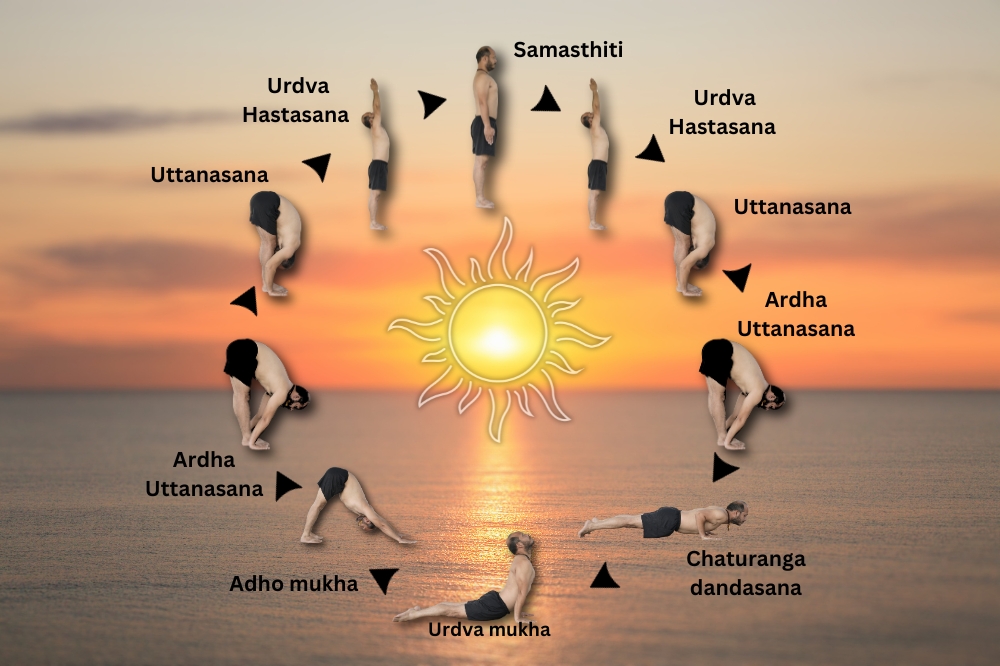
    Sun Salutations (Surya Namaskar):

    Hatha Yoga - Surya Namaskar

    Sun salutations are the foundational sequences that can be performed first or at any time. These sequences link a series of several pictures together in a flowing movement that is synchronised by breath. They are perfect for a complete body workout and can be practiced at various speeds depending on the exercise level of the individual or person doing it.

    These are the beginning yoga poses in Hatha yoga, but as you progress in your practice, you will get to explore a wide range of asanas that will further enhance your flexibility and practice.

    Pranayama (Breathing Techniques): The Power of the Breath

    Hatha Yoga - Pranayama

    Breath plays a vital role in yoga practice, as it is considered the life force. When you understand the connection our body has between the breath and the movements we do, it allows you to control your body’s energy (prana) and enhance and improve your overall practice.

    Simple breathing exercises:

    Ujjayi (Victorious Breath):

    In this breathing technique, you need to constrict your throat slightly while inhaling and exhaling, creating a soft, hissing sound. This breathing technique focuses mainly on the mind and helps in energising the body.

    Dirga Swasam (Three-Part Breath):

    As stated by the name, you are required to divide your breath into three parts. First you will fill your lower belly, then you will move to the mid-ribs and, in the end, the upper chest. And then you will have to exhale in the reversing sequence. The breath brings peace and promotes overall relaxation by calming your nervous system.

    Benefits of Mindful Breathing:

    Mindful breathing techniques help you build focus and create a sense of inner peace and well-being. When you focus solely on your breathing, it helps in distracting your mind and reducing stress while improving overall concentration and boosting the sense of calmness within.

    Getting Started with Hatha Yoga: The Essentials You Need

    We have already discussed the asanas and postures and what you will learn. But still, there might be many questions coming into your mind about beginning the class. This section will give you the knowledge to navigate your first class and make you feel comfortable while stepping onto your yoga mat.

    A Breakdown of the Class Structure:

    Every Hatha yoga class follows a well-defined set of structures that allow you to form practice and ease into the practice with rhythm. Here is what you can expect:

    • Warm-up (5–10 minutes): You will begin with some gentle movements and stretches to prepare your body for more activeness and asana practice.
    • Asana Practice (30–45 minutes): This is the essential part of the class, where you will flow both physically and mentally through a sequence of postures that are designed specifically to improve overall bodily strength, flexibility, and balance.
    • Cool-down (5–10 minutes): After some heavy movements, you will go through some calming stretches and postures to help your body get calm and transition from exertion to relaxation.
    • Relaxation (5–10 minutes): The class will end with a relaxation pose like Savasana (corpse pose), which is the final stage that allows your body and mind to completely relax and integrate the practice.

    Respecting Etiquette:

    Respect and mindfulness are essential elements to keep in mind while practicing yoga. Here are some helpful points to remember in order to maintain an inclusive and positive environment in the classroom:

    • Arrive early: Punctuality is the key; try to arrive a few minutes early for the class. This will allow you adequate time to settle in, resolve your query, and find a comfortable spot.
    • Maintain personal space: While keeping a focus on your practice, do not forget to be aware of your fellow yogis too. Maintain a respectful distance between the mats for better focus.

    Choosing Your Perfect Class:

    For individuals with different levels, there are a variety of Hatha yoga class types, each catering to the specific needs of individuals. Here is how you can find the right fit for you:

    • Beginner Hatha: These classes are designed for newcomers and teach you the fundamental postures of Hatha Yoga with clear instructions and modifications for beginners.
    • Gentle Hatha: These classes are beneficial for those individuals who are going slow in their practice with some limitations, as these classes focus on relaxation and general stretches only.
    • Restorative Hatha: These classes utilise props for support and include advanced postures for passive stretching and deep relaxation.

    Finding a Qualified Instructor:

    A supportive and qualified instructor plays a vital role in guiding you safely and effectively in your yoga journey. It is essential to look for someone with years of experience in teaching Hatha Yoga.

    Also, look for a yoga school that is registered with the Yoga Alliance and has a good reputation for teaching and conducting classes, such as Bali Yogshala

    Preparing for Your First Class:

    Don’t be nervous; just be mentally prepared, and it can ease your first-class jitters. Here’s what you can pack and bring to the class:

    • Comfortable Clothing: Wear loose clothes that allow you to move freely. You can also go for natural fabrics like cotton.
    • Yoga Mat: A yoga mat is a one-time investment, so get one that provides ample support and cushioning.

    Conclusion:

    As you begin your journey with the practice of Hatha yoga, remember the array of benefits it offers. Do not forget to maintain a regular practice, as it is the key to a flexible and strong body with improved balance. But apart from its physical aspects, it can also be a powerful tool for various mental issues, which include stress management, inner peace, and relaxation. The mindful breathing techniques this yoga offers will not only benefit you during the class but can also help you become calmer and more focused in your everyday life.

    The wait is over. Just pack your bag, get your mat, and begin learning Hatha yoga now. There are countless resources available to you to support you on your journey. Many reputable yoga studios, such as Bali Yogshala, offer introductory classes to provide you with a wealth of information and proper guidance and inspiration. So take the first step and begin your practice while discouraging the immense benefits of this beautiful practice.

    Get in Touch:
    Best Yoga Teacher Training In Bali | 100 Hour Yoga Teacher Training In Bali | 200 Hour Yoga Teacher Training In Bali