Tag: yoga asanas

  • Top 25 Reasons to Join a Yoga Retreat: Recharge, Reconnect, and Rejuvenate

    Top 25 Reasons to Join a Yoga Retreat: Recharge, Reconnect, and Rejuvenate

    There are times when we feel so stressed out that the urge to leave everything behind and go to a place that offers some kind of relaxation takes us over. We all have felt that once while working or either when we get bored at our homes doing nothing, we live in a fast-paced world and feel something like this is normal, and at this time, yoga retreats benefit as the best hideout.

    Yoga retreats are specific spaces and dedicated places that are purposely intended to give each individual a special area designed for them to relax both body and soul as they search for themselves. It is most often located in a quiet place in nature and provides a refined programme that includes daily bombings of various classes and sessions containing meditation, yoga practice, nutritious meals, and sometimes a list of exploration and relaxation.

    Yoga retreats for beginners have become very popular these days, and there are many reasons for this: people are becoming more conscious of their mind and body and are seeking means to maintain or have a healthy state of mind. The feelings that a yoga retreat diminishes, however, do not end there; there is more to the usefulness of a yoga retreat. They provide you with an opportunity to reflect on the matters of life, nature, and life itself, and to be with people who will accept you as you are.

    But wait. We are not stopping here. In this blog, you will find a breakdown of the top 25 reasons that can convince anyone that a yoga retreat might be exactly what he or she needs to relax, refresh, and revive not only the body but also the mind.

    Disconnection and Rejuvenation

    1. Escape the everyday: Disconnect from technology and the daily grind.

    We are in a world where we are connected to family, society, work, and so much more, and sometimes it can be hard not to be overwhelmed by the sheer weight of it.

    This time, a yoga retreat can give you a good chance to neglect the daily scramble for opportunities and focus on yourself. It will allow a person to leave their daily routine behind, take a break from technology, and simply improve their quality of life.

    2. Stress reduction: find deep relaxation and combat stress.

    Stress is another health challenge that most people, particularly youths, endure, affecting not only our psychological but also our physiological health. To handle it, a yoga retreat programme is effective since it provides a sequence of meditation and practice sessions.

    These practices are said to be beneficial in eliminating stress and thus bringing about a relaxing environment. From sunrise to sunset during your retreat, you will be taught skills on how to cope with stress in times of need, even after coming back from the retreat.

    3. Digital Detox: Break free from the constant notifications and information overload.

    Do you ever wake up in the morning looking at your mobile phone and loading yourself with information every minute? Well, it is true for most people today, as research has it at 90% and above. And this constant stream of messages becomes overwhelming for us, and we get to a point where we cannot concentrate on one task.

    While a yoga session can be a more practical way of achieving an ideal posture and a healthy lifestyle, a yoga retreat may provide an opportunity for you to turn off your receiver and be offline. This will assist in ensuring that one has a focus and feels more part of the moment while being conscious of people and the elegance of the world around them.

    4. Reconnect with nature: Immerse yourself in stunning natural environments.

    Spending time in nature is considered to have a variety of benefits, both physically and mentally. Nature has its own healing power, and when you immerse yourself in it, it makes you feel refreshed, centred, relaxed, and connected to the world around you.

    Many yoga retreats for beginners, such as Bali Yogshala, are located in beautiful and serene locations such as Bali, which is also known as the Island of Gods, to help you connect better with both yourself and nature.

    5. Prioritise self-care: Dedicate uninterrupted time for your well-being.

    Often, when it comes to work, we forget to pay much attention to our overall well-being, which results in an overwhelmed and exhausted mind and body.

    A yoga retreat, on the other hand, offers us a dedicated place to care for ourselves. Through yoga, meditation, and healthy eating, you will have ample time to focus on your well-being. And along with this, it will also offer you ample time to relax, recharge, and return feeling renewed.

    Deepen Your Yoga Practice:

    6. Structured practice: daily yoga classes led by experienced instructors.

    More specific to the best yoga retreats, the set of programmes provided a distinct schedule of different types of yoga classes. The above wellness retreats do not compare with different studio classes where you can find only one sort of yoga style, and the stress reduction retreats mentioned consist of various classes that provide you with an opportunity to examine different sides of yoga.

    These classes are frequently taught by capable instructors who help lead you to your personal growth and help find ways to keep you safe and practice well throughout the programme.

    7. Explore different yoga styles: Try new yoga styles and find what resonates with you.

    Yoga comes in many types or forms, each with its own principles and techniques for performing the practice. A retreat could include more structured classes in Vinyasa, Hatha, Yin, restorative, or Iyengar yoga, and this would give you an opportunity to find out more about forms of yoga that you may like. This exploration enriches one`s knowledge about yoga practices and assists in the choice of the most suitable practice for the individual.

    8. Personalised guidance: Receive feedback and adjustments from qualified yoga teachers.

    In a large studio class, individual teacher-student contact is relatively small, thereby making it difficult to attend to each student effectively. Wellness retreats, with fewer learners in each class, allow the teachers to get a glimpse of what you are practicing and give feedback and suggestions for changes to be made. This can assist you in enhancing the various poses, preventing injuries, and coming up with better strategies at the next level.

    9. Master new techniques: Learn advanced yoga poses, breathing exercises, and meditation techniques.

    Besides, yoga retreats for beginners may offer more focus on yoga than common classes, alongside other related activities. You might learn some complicated yoga asana, which could be not only physically but also mentally demanding.

    Besides that, stress reduction retreats also spend some time on pranayama, breath control, and different types of meditation, which would only be beneficial to one’s practice and outlook on the concept of the art of yoga.

    10. Develop a consistent routine. Establish a strong foundation for a regular yoga practice at home.

    The daily schedule and topics of a yoga retreat can provide you with a well-rounded yoga class. As suggested above, you should stay on course in executing your yoga techniques at home with regular practice and advice from a well-trained master. After the end of the retreat, you will leave with motivation and knowledge to practice yoga as it fits into your busy life.

    Health and Wellness:

    11. Nourish your body: Enjoy delicious and nutritious meals.

    Some of the wellness retreats focus on maintaining a healthy nutritional status. It may include fresh and locally sourced foods of either quality or nutritional value, prepared well. The change from nutrient-deficient processed meals to consuming fresh, whole food will make you feel more energised, aid digestion, and promote well-being in body and mind.

    12. Improve sleep quality: Establish healthy sleep patterns.

    Stress and noise, among other factors, lead to problems that affect the nature and duration of sleep one gets to enjoy. This is because yoga retreat destinations are held in very distant places with little or no external interference, hence providing an excellent feel for stress reduction retreats.

    Moreover, activities such as yoga and meditation can complement the creation of a more effective sleeping schedule. It has been seen in many cases that getting up feeling fresh gives a boost to one’s energy levels as well as health.

    13. Boost your energy levels: renew your energy reserves

    Aspects like practicing yoga, maintaining a healthy diet, and performing meditation during a retreat can greatly enhance your energy. This practice of yoga can also assist in combating poor circulation, while on the other hand, meditation decreases stress hormones, which drain your energy. Furthermore, the emphasis on whole foods ensures the body receives proper nutrients, hence its ability to optimise its functions.

    14. Increase flexibility and strength: Enhance your physical well-being

    Yoga, as one of the key constituents of a majority of wellness retreats, entails regular exercise that has a massive impact on the level of flexibility and sturdiness of the body.

    Moving further to the retreat, specifically changes in muscular tone, flexibility is also observed to be enhanced, and a feeling of power throughout the body is evident. These gains in mobility and power can enhance the routine tasks and exercise regimes of your life.

    15. Weight management: healthy eating habits and mindful movement practices.

    Yoga retreats benefits for those having difficulties developing proper diets and regular exercises necessary to stabilise weight. Since the diet comprises whole foods and the portions that are consumed during meals, the calorie intake is controlled and can easily allow for weight loss or the maintenance of a healthy weight through the calorie burnt during yoga.

    Nevertheless, it is critical to stress that yoga retreat destinations are not solely weight-loss programmes that help individuals shed extra pounds and become more attractive. Their focus is more on generic health.

    Community and Connection

    16. Meet like-minded people: Connect with others who share your passion.

    Some yoga retreat centres cater specifically to certain professions or age groups, while others are open to anyone who shows an interest in yoga. This results in the formation of a community where people willing to join understand the whole process they are about to go through and the lessons they are about to learn that will allow them to extend morale support to others. It is also rather valuable to exchange stories and have conversations with people like us; it makes one feel that we are together.

    17. Build friendships: Foster meaningful connections.

    Friendship and successful interpersonal relationships have been tested and strengthened throughout the yoga retreat. Some of the major components of the shared activities are spending hours practicing yoga, taking meals together, engaging in activities, etc. All of these give a sense of togetherness. It is important for these connections to develop into actual friendships that can be sustained beyond the retreat.

    18. Cultural exchange: learn about different cultures and perspectives.

    Most of the organised and best yoga retreats aim to attract participants from different parts of the world. This makes it possible to learn a cultural value or tradition from another group of people or society. You can meet people with different and even opposite points of view, which can expand the amount of information about different aspects of life.

    19. Sense of belonging: Feel part of a supportive community.

    Yoga retreat destinations allow someone to feel secure in the type of community that will embrace him or her and nurture the need to search within. Having like-minded people who are also struggling with their body image and undergo a similar transformation process helps to establish a sense of community. This feeling of being part of something can indeed be very useful, especially in this world that offers constant distractions and busy lifestyles.

    20. Shared experiences: Create lasting memories with others.

    Yoga retreats for beginners are also advantageous since it’s during these times that you can make memorable moments with other people. Whether a person is attending group yoga sessions or going for nature walks, the participants will go through activities that will make them bond with others attending the retreat. It means that some of the moments that you experience may be similar to those of thousands of other people, and, as a result, one can have a great time recalling the stories for many years.

    Personal growth and transformation

    21. Set intentions: Identifying your goals.

    When we feel confused over a situation and don’t know what to do, yoga practices and yoga retreats benefits clarify our minds and identify our goals in life. They help us make some specific goals, get more engaged in the process of self-development, and get value from the retreat.

    22. Practicing self-reflection: Gaining a deeper understanding of yourself

    Yoga and meditation are ideal for those who seek to examine themselves and enhance their well-being. On the retreat, there will be ample time where all your concentration will be on you. Consider the thoughts and emotions that will dwindle deep inside of you. The kind of self-reflection possible through practice can foster personal transformations and a compelling vision of life.

    23. Embrace mindfulness: learning to be present in the moment.

    Another fundamental concept of yoga is awareness, where one is only concerned with the present time. On the way to a yoga class, through the practice of yoga and meditation, you will open yourself to ways of concentration and relaxation in your daily life. These changes can then affect one’s day-to-day life, lead to a happier, less stressed life, and thus be effectively used to improve the user’s quality of life.

    24. Sparking creativity: Allowing yourself space for inspiration and new ideas.

    Through distancing oneself from the stress of the day-to-day routine, the result of a yoga retreat may be increased creativity and ideas. Less noise, free of the material worries and clutter of your mind, can lead to new ideas. This can be helpful as a place to address some difficulties as well as practice creativity or introduce new attitudes to life.

    25. Return home renewed: Leave the retreat feeling empowered.

    A yoga retreat gives you the opportunity to make a new start and come back refreshed and full of energy. The most frequently reported positive feelings include sharpness of thought, self-identity, and awareness and appreciation of health. With this new way of thinking, you can be better prepared each time events occur in your life, allowing you to handle them with positivity.

    Conclusion

    Yoga retreats for beginners are a perfect opportunity to get away from it all, which, given the fast pace of today’s society, is a luxury and perhaps even a necessity. Yoga retreat destinations have numerous benefits that we have discussed here, including 25 reasons why a yoga retreat is the best way to revive yourself.

    Whether it is about becoming a better yogi, physical exercise, or spiritual growth and development, the best yoga retreats are rewarding programs. If you ever get to a point where everything seems to be piling up and you get that feeling that you need a change, then a yoga retreat could be the place to be. It may even amaze you how it brings about some good changes to the body, the mind, and the soul.

    Get in Touch:
    Best Yoga Teacher Training In Bali | 100 Hour Yoga Teacher Training In Bali | 200 Hour Yoga Teacher Training In Bali

  • Unlock the Secrets of Hatha Yoga: A Positive Journey for Beginners

    Unlock the Secrets of Hatha Yoga: A Positive Journey for Beginners

    Yoga is an ancient and dynamic practice that has its roots in India, and among a wide range of different yoga styles, Hatha yoga is considered the beginning and foundation for modern yoga styles. The word hatha has a meaning infused, which translates as “ha” meaning sun and “tha” meaning moon in Sanskrit. It showcases and puts much value in the concept of balance, which represents using opposing energies within us in union.

    If you are a beginner and are exploring your way into yoga, then practicing Hatha yoga can bring you a number of great benefits. It includes a subtle mix of various asana practices and mindful breathing techniques (pranayamas), which not only improve your flexibility but also strengthen your body and enhance your overall well-being. While regular practice can help with a lot of things, including stress reduction and fostering inner peace,. 

    So if you are curious about how yoga can enhance and improve the quality of your life and how much potential it has for changing your life, then Hatha yoga is the perfect to begin the oracle.

    Hatha Yoga

    The Essentials of Hatha Yoga Practice

    Asanas (Postures): The Foundation of Movement

    Asanas, or the physical postures, are the core aspects of Hatha yoga, and in this section, we will discuss exploring and maintaining some fundamentals to have an effective and safe practice.

    Alignment and Breathwork: The Guiding Principles

    Before beginning any specific posture, you need to keep these two things in mind:

    Alignment:

    Proper alignment is the only way to save yourself from any injury or mishap during the practice. While ensuring safety, they also maximise the benefit of each pose. Choose a qualified and experienced yoga instructor, as it will be helpful to provide you with the correct guidance on optimal alignment for each asana.

    Breathwork (Pranayama):

    In yoga, breath is considered a powerful bridge between mind and body. When you coordinate your body movements with your breath, it brings focus and control to your practice. It’s best to focus on inhaling while you open your body and exhaling as you release the tension.

    Beginner-Friendly Asanas:

    Let’s take a quick note on some basic poses, categorized by how they function:

    Standing Poses (Balance and Strength):

    Tadasana (Mountain Pose):
    • Stand tall with your knees straight.
    • Keep your feet hip-width apart.
    • Ground through your soles.
    • Stretch your arms up and stand on your feet.
    • Come down, stand at your feet, and put our hands down. Repeat a few times.
    Vrikshasana (Tree Pose):
    • Stand straight and tall to balance your body on one leg.
    • Hold the other leg and place it on the inside of your thighs.
    • Join both your palms in a Namaste and bring it to your chest.
    • Hold the pose and breathe steadily.
    Benefits of Standing Poses
    • It helps reduce the overall body weight.
    • Strengthen the ankles, hips, and chest.
    • Improves digestion and concentration.
    • It calms the mind and releases stress.
    • Stretch the thigh muscles and abdominal organs.

    Forward Bends (Flexibility and Inner Peace):

    Balasana (Child’s Pose):
    • Kneel down on the floor.
    • Keep your feet placed on the mat.
    • Take a breath and spread your knees to the length of your hips.
    • Keep your shoulders on your knees.
    • Extend your hands straight upwards and rest them on the mat.
    Uttanasana (Standing Forward Fold):
    • Stand straight on your feet and keep your spine straight.
    • Balance your weight equally on both legs.
    • Keep your arms over your head and motion your breathing while inhaling.
    • Enhale, stretch your body, and hinge at the hips.
    • Bend forward completely with a flat back.
    • Fold your body down towards your feet.
    Benefits of forward-bending poses:
    • Strengthen the thighs, knees, and legs.
    • It helps reduce tension in the lower back.
    • It helps in stretching the back, spine, and hips.
    • It calms the mind and balances the nervous system.
    • Improves the digestive system.

    Twists (Detoxification and Digestion):

    Marjariasana (Cat-Cow Pose):
    • Sit in the table-top position.
    • Keep your palms, knees, and toes on the floor.
    • Engage your core and draw your belly button inward.
    • For the cat pose, arch the back and drag your belly towards the mat.
    • Hold your breath and feel the stretch in your back and core.
    • For the cow pose, exhale and round the back towards the ceiling.
    • Tuck your chin to the chest while engaging your core.
    • Feel like you are pushing the floor away from you.
    • Hold your breath and feel the stretch in your neck and shoulders.
    Vakrasana (Seated Twist):
    • Sit on the floor and extend your legs in front.
    • Engage your core and keep your spine erect and straight.
    • Extend your arms out to the sides while keeping your palms facing down.
    • Fold your right leg and bring your foot outside of your left thigh.
    • Bring your left arm behind you while keeping the right one on the left knee.
    • Maintain breathing, and repeat it on the other side.
    Benefits of Twists:
    • Improves muscular balance and coordination.
    • It calms the nervous system.
    • Creates space in the hips, shoulder, and spine.
    • It helps relax the muscles around the spine.
    • Aid in decompressing the spinal column.

    Sun Salutations (Surya Namaskar):

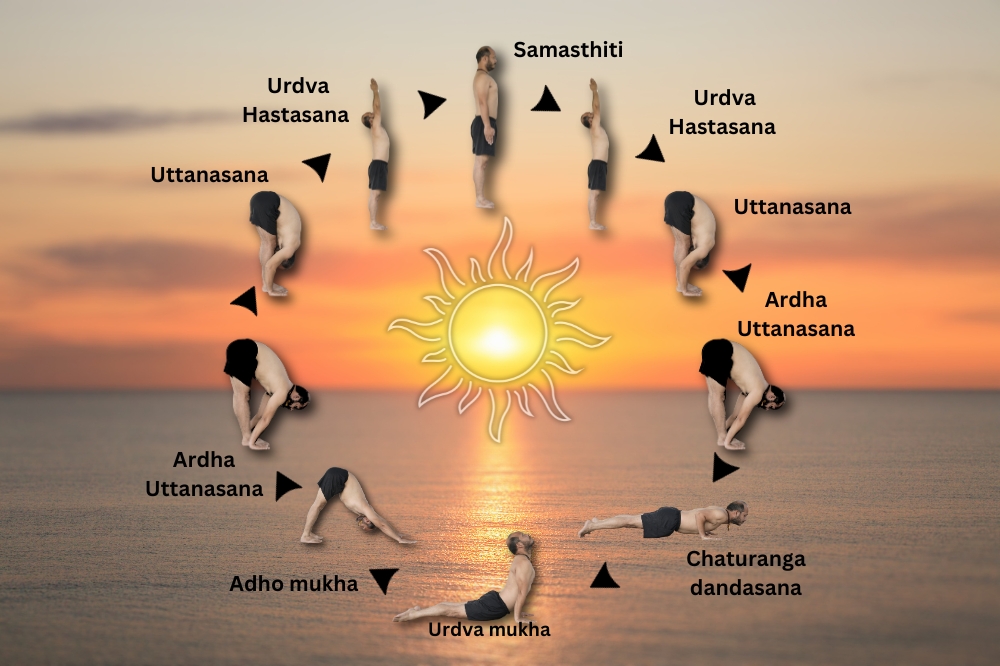
    Hatha Yoga - Surya Namaskar

    Sun salutations are the foundational sequences that can be performed first or at any time. These sequences link a series of several pictures together in a flowing movement that is synchronised by breath. They are perfect for a complete body workout and can be practiced at various speeds depending on the exercise level of the individual or person doing it.

    These are the beginning yoga poses in Hatha yoga, but as you progress in your practice, you will get to explore a wide range of asanas that will further enhance your flexibility and practice.

    Pranayama (Breathing Techniques): The Power of the Breath

    Hatha Yoga - Pranayama

    Breath plays a vital role in yoga practice, as it is considered the life force. When you understand the connection our body has between the breath and the movements we do, it allows you to control your body’s energy (prana) and enhance and improve your overall practice.

    Simple breathing exercises:

    Ujjayi (Victorious Breath):

    In this breathing technique, you need to constrict your throat slightly while inhaling and exhaling, creating a soft, hissing sound. This breathing technique focuses mainly on the mind and helps in energising the body.

    Dirga Swasam (Three-Part Breath):

    As stated by the name, you are required to divide your breath into three parts. First you will fill your lower belly, then you will move to the mid-ribs and, in the end, the upper chest. And then you will have to exhale in the reversing sequence. The breath brings peace and promotes overall relaxation by calming your nervous system.

    Benefits of Mindful Breathing:

    Mindful breathing techniques help you build focus and create a sense of inner peace and well-being. When you focus solely on your breathing, it helps in distracting your mind and reducing stress while improving overall concentration and boosting the sense of calmness within.

    Getting Started with Hatha Yoga: The Essentials You Need

    We have already discussed the asanas and postures and what you will learn. But still, there might be many questions coming into your mind about beginning the class. This section will give you the knowledge to navigate your first class and make you feel comfortable while stepping onto your yoga mat.

    A Breakdown of the Class Structure:

    Every Hatha yoga class follows a well-defined set of structures that allow you to form practice and ease into the practice with rhythm. Here is what you can expect:

    • Warm-up (5–10 minutes): You will begin with some gentle movements and stretches to prepare your body for more activeness and asana practice.
    • Asana Practice (30–45 minutes): This is the essential part of the class, where you will flow both physically and mentally through a sequence of postures that are designed specifically to improve overall bodily strength, flexibility, and balance.
    • Cool-down (5–10 minutes): After some heavy movements, you will go through some calming stretches and postures to help your body get calm and transition from exertion to relaxation.
    • Relaxation (5–10 minutes): The class will end with a relaxation pose like Savasana (corpse pose), which is the final stage that allows your body and mind to completely relax and integrate the practice.

    Respecting Etiquette:

    Respect and mindfulness are essential elements to keep in mind while practicing yoga. Here are some helpful points to remember in order to maintain an inclusive and positive environment in the classroom:

    • Arrive early: Punctuality is the key; try to arrive a few minutes early for the class. This will allow you adequate time to settle in, resolve your query, and find a comfortable spot.
    • Maintain personal space: While keeping a focus on your practice, do not forget to be aware of your fellow yogis too. Maintain a respectful distance between the mats for better focus.

    Choosing Your Perfect Class:

    For individuals with different levels, there are a variety of Hatha yoga class types, each catering to the specific needs of individuals. Here is how you can find the right fit for you:

    • Beginner Hatha: These classes are designed for newcomers and teach you the fundamental postures of Hatha Yoga with clear instructions and modifications for beginners.
    • Gentle Hatha: These classes are beneficial for those individuals who are going slow in their practice with some limitations, as these classes focus on relaxation and general stretches only.
    • Restorative Hatha: These classes utilise props for support and include advanced postures for passive stretching and deep relaxation.

    Finding a Qualified Instructor:

    A supportive and qualified instructor plays a vital role in guiding you safely and effectively in your yoga journey. It is essential to look for someone with years of experience in teaching Hatha Yoga.

    Also, look for a yoga school that is registered with the Yoga Alliance and has a good reputation for teaching and conducting classes, such as Bali Yogshala

    Preparing for Your First Class:

    Don’t be nervous; just be mentally prepared, and it can ease your first-class jitters. Here’s what you can pack and bring to the class:

    • Comfortable Clothing: Wear loose clothes that allow you to move freely. You can also go for natural fabrics like cotton.
    • Yoga Mat: A yoga mat is a one-time investment, so get one that provides ample support and cushioning.

    Conclusion:

    As you begin your journey with the practice of Hatha yoga, remember the array of benefits it offers. Do not forget to maintain a regular practice, as it is the key to a flexible and strong body with improved balance. But apart from its physical aspects, it can also be a powerful tool for various mental issues, which include stress management, inner peace, and relaxation. The mindful breathing techniques this yoga offers will not only benefit you during the class but can also help you become calmer and more focused in your everyday life.

    The wait is over. Just pack your bag, get your mat, and begin learning Hatha yoga now. There are countless resources available to you to support you on your journey. Many reputable yoga studios, such as Bali Yogshala, offer introductory classes to provide you with a wealth of information and proper guidance and inspiration. So take the first step and begin your practice while discouraging the immense benefits of this beautiful practice.

    Get in Touch:
    Best Yoga Teacher Training In Bali | 100 Hour Yoga Teacher Training In Bali | 200 Hour Yoga Teacher Training In Bali

  • Surya Namaskar: A Beginner’s Guide to Sun Salutations

    Surya Namaskar: A Beginner’s Guide to Sun Salutations

    The sun salutation, also known as Surya Namaskar in Sanskrit, is a sequence of yoga poses, as determined by the name, practiced in the morning with a sun rise that links the body movement with breath. It is one of the most beautiful and best ways to warm up your body before any class while building strength and improving flexibility for better alignment. Usually, this practice is often used in the morning or before any yoga class, but you can practice it anytime as a full-body workout.

    But even if you are a beginner or a practiced yogi, practicing this requires a series of steps to be followed with focus so that you can easily enjoy the benefits of these sun salutations. In this guide, we will get you through all the poses step by step with modifications. So let’s get into the learning without wasting a second, with the multitude of benefits it offers for both body and mind.

    Benefits of Sun Salutations

    Warm-up for the body:

    Sun salutations are a great way to warm up and prepare your body for the day’s practice, yoga classes, and any physical activity. They help in moving all the muscle groups in your body gently while increasing the blood flow and loosening up all the tight areas for better practice.

    Improves flexibility and strength:

    Various poses aligned in sun salutation are usually related to stretching, which also strengthens different muscle groups throughout the body. So if you practice these poses daily, it can eventually result in improved flexibility and build up strength in the back, arms, legs, and core.

    Increases circulation:

    Practicing these salutations requires body strength, and as with any other practice, it gets your heart rate up, resulting in improved circulation throughout the body. This practice helps deliver the major nutrients and oxygen to the cells more efficiently and removes waste products from the body.

    Promotes mindfulness:

    Practicing these salutations requires focus on your breath and movements, which lead to a quiet mind and promote mindfulness. Through this, you can better start your day in a great way or de-stress your mind after a hectic day.

    Before you begin: Be Prepared

    Before you begin your movements, preparing for them is essential for an enhanced practice. While not necessary, having a yoga mat will help you with better grip and cushioning for your practice. Additionally, having comfortable clothes on will allow for better and easier movements.

    Breathe Easy:

    Sun salutations are all about synchronising your breath with your body movements, so here’s a quick tip:

    • Inhale: Fill your belly with air and breathe in through your nose as you expand your body or lengthen it (while keeping your arms up or getting back into the plank).
    • Exhale: Release all your tension as you exhale through your nose or mouth while you fold or contract your body. (Usually during a forward fold or downward-facing dog.).

    Keeping your focus on these breathing techniques will help you move your body with flexibility and fluidity while connecting it with your mind throughout the sequences.

    The Sun Salutation Sequence: Step-by-Step 

    The sun salutation sequences are a flowing series of twelve poses that are linked together with each other with breath. Let’s get to it:

    1. Mountain Pose (Tadasana):

    How to do:

    • This pose begins with standing tall with your feet.
    • Keep your hip width apart from the feet, and evenly distribute the body weight to all four corners of your feet.
    • Draw your navel in slightly while engaging your core. 
    • Stack your shoulders over your hips directly.
    • Lift your head crown and lengthen your neck.
    • Breath in and out, both deeply and evenly.

    Benefits:

    • It helps improve posture.
    • Reduce hip and back pain.
    • Strengthens core and leg muscles.
    • Regulate digestion and respiration.
    • And promotes a sense of grounding.

    2. Raised Arms Pose (Urdhva Hastasana):

    How to do:

    • Take a deep breath, inhale, and raise your arms overheated.
    • Join your hands in prayer form, reaching through your fingertips.
    • Keep your shoulder blades down and back, to your flexibility level.
    • Keep your gaze softly upwards.

    Benefits:

    • It opens the chest.
    • Increases the flexibility
    • Strengthens shoulders and arms
    • Give strength to the back muscles by lengthening the front.
    • Energises the body.

    3. Forward Fold (Uttanasana):

    How to do:

    • Inhale and hinge at your hips.
    • Fold your sleeves forward.
    • Bring your hands on top of or alongside your feet.
    • Give length to your spine as per your flexibility.
    • Relax your neck and head.
    • Let your head hang heavy for a while.

    Benefits:

    • It aids digestion.
    • It stretches the hamstrings and calves.
    • Ease, stress, tension, and fatigue.
    • Improves circulation in the body and muscles.
    • It calms the mind.

    4. Halfway Lift (Ardha Uttanasana):

    How to do:

    • Inhale and lengthen your spine.
    • Stretch your hands straight.
    • Reach to your shins or the floor.
    • Keep your face forward and bend your knee if required.

    Benefits:

    • It helps in maintaining a healthy curvature of the spine.
    • It strengthens the core and back muscles.
    • It helps prepare the body for bending postures.
    • It stretches the hamstrings.
    • Improves spinal flexibility.

    5. Plank Pose (Phalakasana):

    How to do:

    • Exhale and lower yourself to a plank position.
    • From head to heels, keep your body in a straight line and your core engaged.
    • Put your weight equally on your legs and hands. 
    • Gaze down between your hands and mind your breathing.

    Benefits:

    • Improve the posture and body balance.
    • Strengthens the core, shoulders, arms, and wrists
    • improves body flexibility.
    • Builds overall stability.
    • Removes backache.

    6. Low Plank/Knee-Chest Pose (Chaturanga Dandasana):

    How to do:

    • If you find the Plank pose challenging,
    • In this pose, you can lower your body to the mat instead of keeping it in a straight line.
    • Keep your core engaged.
    • Lengthen the spine.

    Benefits:

    • Strengthen and tone the abdominal region.
    • Relieve lower back pain.
    • Strengthen the muscles and body.
    • Provides stability.

    7. Upward-Facing Dog (Urdhva Mukha Svanasana):

    How to do:

    • Inhale and push yourself up off the mat.
    • Put your body up in an upward-facing dog pose.
    • Begin by arching your back.
    • Slowly press your chest forward.
    • Loog upward and lengthen your neck as much as possible.
    • Keep your legs strong and your core engaged.

    Benefits:

    • It stretches the body and intercostal muscles.
    • It strengthens the back, shoulders, arms, and core.
    • It helps counteract regular forward flexion activities.
    • Open the chest.
    • Improves flexibility in the spine.

    8. Downward-Facing Dog (Adho Mukha Svanasana):

    How to do:

    • Exhale and push your hips back and up (opposite of the previous pose).
    • Put your body in a downward-facing dog pose.
    • Create an inverted V shape with your body.
    • Press your heels and body on the mat to achieve the pose as closely as possible.
    • Push your chest forward and lengthen your spine.
    • Keep and maintain your gaze between your legs.

    Benefits:

    • It elongates the spine.
    • It stretches the hamstrings, calves, and shoulders.
    • It helps relieve tension and stress.
    • Strengthens the core and arms,
    • Improves circulation in the body.

    9. High Lunge (Ashwa Sanchalanasana):

    How to do:

    • Inhale and step one foot back between your hands.
    • Keep your knees to the floor and bend at a 90-degree angle.
    • Keep and maintain your hips squared and forward.
    • Keep your gaze forward and slightly upward.

    Benefits:

    • Bring stability to the body.
    • It stretches the hip flexors, quadriceps, and groyne.
    • It helps in improving joint function.
    • Strengthens the legs and core,
    • Improves balance.

    10. Halfway Lift (Ardha Uttanasana): Repeat from the other leg:

    This pose is the same as the halfway lift pose but can be done with the other leg by stepping it back between the hands. (Read number 4 pose instructions.).

    11. Forward Fold (Uttanasana): Repeat the Forward Fold:

    This pose is a replica of the forward-fold pose and can be done from a new standing position. (Read number 3 pose instructions.).

    12. Raised Arms Pose (Urdhva Hastasana): Repeat Reaching Arms Up:

    For this pose, you need to repeat the raised arm pose by keeping your arms overhead and inhaling (read number 2 pose instructions).

    13. Mountain Pose (Tadasana): Return to Starting Position:

    Exhale and return to the beginning, where we started from the mountain pose (number 1).

    This completes one round of sun salutations. You can repeat the poses with the other side as well and include this in your regular practice for improvement and warming up.

    Sun Salutations Made Easy: Modifications for New Yogis

    Sun salutations are beneficial for individuals of all levels and can be adapted by anyone. But if you are new to this practice, here are some tips to help you with better awareness and practice:

    Focus on form over perfection.

    We can achieve perfection with great practice, so it’s better to first focus on the alignment of the body correctly in each pose. It’s better to go slow and steady and adapt accordingly than push yourself and your body beyond their limits.

    Bend your knees.

    All the sequences usually require a straightened body and knees, so it is completely okay to bend your knees as many times as needed throughout the sequence practice. Poses like plank pose and downward-facing dog pose require a lot of strength, so keep your body energy neutral and bend as needed if required to maintain a proper form and protect your joints from any injury or pain.

    Utilise props

    Rather than trying one thing 100 times, try using props such as yoga blocks, which can be a great tool for all beginners. You can use them for elevating your hands for sequences like forward folds or to support you under your knees in plank pose.

    Listen to your body

    One of the most essential pieces of advice that we can give to you all reading this out there is that you should and must pay attention to the signals your body gives you. Take proper breaks whenever needed, and go slow and steady as per your convenience and health.

    Utilising and following these tips and modifications will let you enjoy the immense benefits of sun salutations at their maximum, regardless of what experience level you have.

    Conclusion

    Sun salutations are a great and fantastic way to warm up your body and begin your day. It is also effective in energising the body and relaxing it after a long day. By including this beneficial practice into your daily routine, even if you practice it a few times a week, you can experience the array of benefits it has to offer to your body, mind, and soul.

    So even though you are a beginner, don’t wait any longer; roll down your mat, and if not, you can just begin with a clean floor and give these sequences a try on your own. Be ready to be shocked and surprised by the quick benefits you will get to see in a few weeks. Make them a part of your well-being journey and guarantee the health check ahead.

    Get in Touch:
    Best Yoga Teacher Training In Bali | 100 Hour Yoga Teacher Training In Bali | 200 Hour Yoga Teacher Training In Bali
  • The Yogic Diet: Understanding the Role of Nutrition in Yoga Practice and Teaching 

    The Yogic Diet: Understanding the Role of Nutrition in Yoga Practice and Teaching 

    One of the most essential things to perform or even function well in any task is energy. We should have enough energy to perform any task with full enthusiasm, and when it comes to practicing yoga, it requires an even greater amount in our body. Imagine when all the other people around you are involved in their practice without stopping; you just look at them with tiredness all over. Sounds bad, right? That’s why having a yogic diet comes into play.

    Food works as fuel for our body, and we should always keep our tank full of good fuel to run as far as we want to on our yogic path. Yogic diet plays a vital role in our yogic journey as it is an ancient dietetic philosophy that is deeply rooted in yogic principles, emphasising the connection between food, body, and mind. It shows us the consumption of healthy food that promotes our overall well-being and supports our practice.

    Understanding the yogic dietetic practice is beneficial for both practitioners and teachers. As for practitioners, including this diet plan in their practice will help enhance and improve their yoga experience by boosting their energy levels. While for yoga teachers, learning and understanding this approach will help them guide their students towards good eating habits to effortlessly complement their physical efforts on the mat.

    Ayurveda: The Pillar of Yogic Dietary Practices

    You all must have known or have gone through this word, “Ayurveda,” which is considered the ancient Indian system of holistic medicine and the foundation of the yogic diet. Ayurveda is translated as the “Science of Life,” emphasising the essentiality of having balance between your body, mind, and soul for better health. This helps in shaping the yogic diet through:

    Doshas

    According to Ayurveda, there are primarily three types of body and mind, which are called doshas (Vatta, Pitta, and Kapha). Each type of dosha has its own unique dietary needs and characteristics. While a yogic diet is a common dietary need that focuses on having Sattvic food that benefits everyone, a more personalised approach to diet based on your body dosha can be explored with Ayurveda.

    Digestive Fire (Agni)

    The digestion system is vital for every body, and in Ayurveda, we should maintain a healthy digestive fire within our body, which is also termed Agni. Thus, the yogic diet promotes various practices that support Agni, which include having regular healthy meals, avoiding any type of processed food, and consuming only those food items that are easy to digest.

    Five Elements

    Ayurveda, being a holistic practice, takes most of the things from mother nature and believes while recognising the five basic elements that are present in nature, the human body, and food itself, which include water, earth, air, ether, and fire. And having a yogic diet aims to create a subtle balance between these elements within our body, which results in a healthy body and overall well-being.

    Food as Energy: Decoding the Secret Language of the Gunas

    Have you ever thought about where this yogic diet we take gets its core principles from? No, well, it takes it from the concept of three Gunas (Sattva, Rajas, and Tamas). These are essential qualities that influence everything in this universe, which includes our food choices and the impact they have on our body and mind. Learning and understanding about these gunas is essential to navigating our yogic diet path.

    Sattva (Purity, Lightness):

    Sattva includes consuming sattvic food, which is considered light and pure and promotes mental clarity and calmness within. This food type contains fresh meals and food items such as fruits, vegetables, whole grains, and legumes. These foods are beneficial in promoting peace, focus, and healthy well-being, which are ideal for performing yogic practice.

    Rajas (Passion, Activity):

    Rajas include Rajasic foods that contain all the benefits related to stimulation, passion, and energy. This dietary potion generally includes spiced food items, meats, and some stimulants, such as coffee. These food items are known to provide a temporary burst of energy within, but later they can also lead to restlessness, anger, agitation, and distraction that can hinder and create difficulty in yoga practice.

    Tamas (inertia, heaviness):

    Tama or Tamasic food items are those that make you feel lethargic, dull, and heavy after consumption. They usually include foods with more oils and fats, such as processed foods, stale foods, and fried foods. Consumption of these foods is considered bad for health and can directly lead to sluggishness, mental fog, and negativity, which make it difficult for you to concentrate or engage in any yogic practice.

    Sattvic Foods: The Fuel for a Healthy Yoga Practice

    As we discussed above, Sattvic food, among all, takes center stage in the yogic diet for a good reason. These food items are the best and most beneficial for a healthy, energetic, and focused yoga practice. Here’s the reason to incorporate it into your diet plan:

    More Energy and Focus:

    Sattvic food items contain essential nutrients that offer you optimal energy throughout the practice. Unlike the temporary boost of energy that Rajasic food items provide, they offer a steady flow of energy that allows you to perform, focus deeply, and maintain optimal performance during the whole session.

    Clarity and Inner Peace:

    The Sattvic food diet focuses on whole-food servings that help with mental clarity and promote calmness. Through this diet plan, you can easily avoid aggression. and sluggishness, and perform the yoga practice in a state of peacefulness. This helps you approach the practice with a clear mind and an openness to experience and explore the complete benefits of yoga.

    Supports Physical Prowess:

    Physical well-being is as essential as mental clarity while performing yoga, and while this sattvic food is also rich in vitamins, antioxidants, and minerals, it healthily contributes to your physical well-being as well, which results in a more strenuous, flexible, and stamina-rich practice. This will also help you perform your yoga posture with ease.

    Core Principles of the Yogic Diet

    Ahimsa (non-violence): What not to have

    Ahimsa, which means walking on the path of non-violence, lies at the heart of the Yogic diet, which extends far beyond simply avoiding any physical harm to others. It believes in having only vegetarian food and avoiding any type of flesh item that causes harm to living creatures. Through this, you can contribute to minimising the suffering in the world and align with the Yogic philosophy of compassion and respect for every living being.

    Moderation and mindful eating: How to have

    This yogic diet principle focuses on how to have them, which includes finding the correct balance. Overconsumption, even of healthy food items, can disrupt your digestive system and create difficulty in practice. You should focus on portion control and consume only enough to nourish the body without excess. You can practice eating slowly and taking small bites while savoring them by avoiding distractions and stopping when full.

    Freshness and Seasonality: What to Have

    The Sattivic diet plan includes having fresh food items as they contain more potent sources of energy, which is beneficial in many ways as compared to processed or out-of-season food. They also maximise the nutritional content within, which provides you with a wealth of antioxidants, nutrients, and vitamins. Including them in your diet will result in good performance and contribute to more strength, stamina, and flexibility.

    Beyond the Asana: Building a Yogic Lifestyle Through Food and Practice

    Yogic dieting doesn’t only include having food in your diet and putting restrictions on it; it’s also more about following what reflects your yogic practice. Here are the benefits you will get from your practice:

    Increased energy levels

    You can incorporate foods like oats, brown rice, and quinoa, as they contain subtle amounts of carbohydrates to keep you going throughout the practice. You can also replace the refined sugar with fresh fruits like bananas, apples, and honey for quick energy. Additionally, eating healthy fat foods such as seeds, avocados, and nuts will contribute to satiety while offering slow-burning energy and preventing hunger pangs during the practice.

    Enhanced Focus and Clarity

    To enhance the overall focus and clarity of your practice, you can incorporate foods that are rich in omega-3 fatty acids, as they can boost brainpower. Also, staying hydrated throughout the day is essential for better cognitive function, for which you can take herbal teas and water. But don’t underestimate leafy greens, as they are filled with minerals, iron, and vitamin B for better focus and clarity.

    Better Strength and Flexibility

    Protein sources such as dairy products, legumes, and tofu help in building muscles and repairing tissues and support the overall strength development of yoga postures. Taking hydration lubricates your joints and allows for better motion and alignment during the yoga practice, while taking foods that are rich in vitamin C, like broccoli, is also good for collagen production as it contributes to overall good health.

    Conclusion:

    In conclusion, a healthy yogic diet is your way to be healthy, energetic, and full of positivity during your yogic practice. It is one of the most essential and powerful approaches to enhancing and improving your overall well-being and yoga practice. By following the core principles like sattvic food and practicing mindful eating, you can fill your body with clarity and subtle energy to truly flourish your mat experience.

    This approach goes beyond just eating and cultivates a holistic lifestyle built on respect for the world and other creatures, as well as your own self. Remember, it is a beautiful journey and a notable destination where you can reach and stop. It is a path you need to take and keep walking. Have, experience, experiment, and explore different food items to find the one that works best for your body type. By knowing and embracing the ancient dietetic practice, you can experience and unlock a connection and balance between your body, mind, and soul.

    Get in Touch:
    Best Yoga Teacher Training In Bali | 100 Hour Yoga Teacher Training In Bali | 200 Hour Yoga Teacher Training In Bali