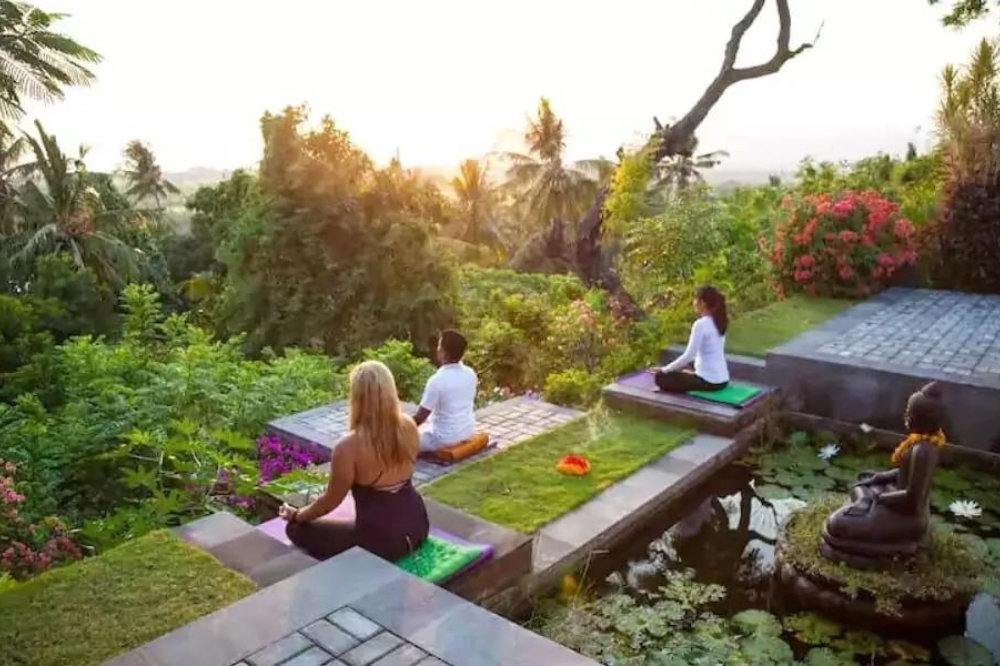
Tag: yoga teacher training in bali

  • The Importance of Breath in Yoga: Techniques for Deepening Your Practice

    The Importance of Breath in Yoga: Techniques for Deepening Your Practice

    When we hear about yoga, the first thing that comes to mind is posture and various yoga asanas, but wait, there is much more to it. Yoga is an ancient practice that people have been practicing for tens of thousands of years that goes beyond just physical postures. Many view yoga as a holistic approach to their overall well-being that aims to create harmony between the spirit, body, and mind.

    A core concept in yoga is called prana, which is a subtle energy that is believed to be the life force that generally flows through all living things. Our breath plays a crucial role in practicing yoga and acts as a bridge between the physical and other subtle aspects of our being. If we get connected with our breath continuously, then we will be able to unlock a wealth of benefits.

    On the physical level, breathwork can benefit us by deepening our stretches, improving our core engagement, and optimising the overall energy flow. Moreover, focusing on breath can also help us calm our mind and reduce stress while cultivating a sense of mindfulness and presence. To summarise it, breath is the ultimatum to achieve anything through yoga and to know our full potential.

    Why is breath important in yoga?

    Have you ever paid attention to the first reaction anyone has when something goes wrong with their body during a practice? You will first be told to control and hold your breath, as it is so crucial in yoga, and there are two main reasons behind it:

    A. Connection Between Breath and Movement (Asanas):

    • Deepening Stretches and Improving Body Awareness: As we inhale, we can expand our body and lengthen it in a pose. When we coordinate our breath with the movement during the practice, it enables us to access deeper stretches and improves our overall awareness of the body, which allows us to achieve a more targeted and effective yoga practice.
    • Optimising Energy Flow Throughout the Body: In yoga, it is believed that the breath is the optimal energy that controls the overall flow of prana, which is the life force within the body. When you focus on smooth and even breaths, it helps you optimise the overall energy flow and results in improving your practice while potentially promoting overall well-being.

     B. Breath and Mental Well-Being:

    • Calming the Mind and Reducing Stress:When we begin to focus on breath, it naturally draws all our attention inward, which helps in quitting the mind and reducing the chatter of thoughts. This practice can bring a sense of calmness and help reduce stress levels.
    • Cultivating Presence and Mindfulness: Focusing on one thing helps us with concentration in another. When we pay close attention to the flow of breath in our body while both entering and leaving, it creates a sense of presence of mind in the present moment and mindfulness. Through this, we can be fully engaged in the moment of activities, both on and off the mat.

    Breath Control Techniques for Yoga

    Now that we know how powerful and impactful breath is in yoga, it’s time to explore some specific techniques that will help you enhance your overall effectiveness:

    A. Ujjayi Breathing (Victorious Breath):

    This breathing technique, often referred to as ocen breathing, is one of the most commonly used and popular forms of breathing used in pranayama.

    Technique:

    • Keep your mouth closed and start inhaling and exhaling the breath.
    • Constrict your throat throughout the movement.
    • Create a soft hissing sound with your breath, more like snoring.
    • Control your breath with your diaphragm.
    • Expand the abdomen during inhalation and engage the core while drawing the breath in.
    • Keep the enhaling and exhaling of equal duration.

    Benefits:

    • Promotes the overall focus during the activity.
    • It helps in maintaining a steady rhythm.
    • Strengthens the core and stabilises the body.
    • Helps in generating internal heat, aiding in detoxification.
    • Releases tension from the body.

    B. Dirga Pranayama (Three-Part Breath):

    Dirga pranayama has a deep meaning, which translates to expanding the breath for a prolonged period of time. Dirgha, which means deep or prolonged in Sankrit when combined with pranayama, reflects this meaning.

    Technique:

    • Firmly inhale and go for three-step breathing.
    • For the first step, inhale through the nose, let the belly expand, move breath to the lungs, and exhale.
    • For step two, do the same, but add the breath to the rib cage as well, and then breathe out.
    • For step three, move one step forward by adding breath to your upper chest as well, and then exhale.
    • During exhalation, ensure to squeeze the belly until it is empty.
    • Reverse the sequence while exhaling slowly.

    Benefits:

    • Helps in relaxing the body and mind.
    • Promotes a sense of calm and well-being.
    • Improves overall oxygen intake and lung capacity.
    • Strengthen the digestive system and improve the immune system.
    • Helps in reducing hypertension and high blood pressure.

    C. Kapalbhati (Breath of Fire):

    Kapalbhati is an energising technique also known as the breath of fire, which also translates as skull-shining breath.

    Technique:

    • Sit comfortably on the mat while keeping your spine erect.
    • Keep your hands on your knees while your palms open upward.
    • Take a deep breath in and focus on your exhaling.
    • During exercise, pull your nevel back to the spine.
    • Relax the navel and abdomen, and let your breath flow into your lungs automatically.
    • Do it 20 times to complete one round of kapalbhati.
    • Relax and do two more rounds of it.

    Benefits:

    • It helps in calming and uplifting the mind.
    • It clears the subtle energy channels in the body.
    • Helps in losing weight while increasing the metabolic rate.
    • Enhances overall lung capacity and makes them stronger.
    • Aid in detoxification and stimulate the digestive system.

    Important Note:

    While these breathing techniques are suitable for better breath control, it is essential to consult and take help from a qualified and skilled yoga teacher and perform them under their guidance before beginning the practice on your own. Especially for those who are dealing with some health concerns.

    Tips for Deepening Your Breathwork

    Take your breathwork to the next level and include these tips in your practice to unlock greater benefits:

    Observe Your Natural Breath Patterns:

    Before choosing any specific breathing technique and diving into the pose, take some time outside and simply observe the pattern of your natural breathing. You need to take into consideration the depth of it, its speed, and the rhythm it has.

    Pay attention to whether it is rapid, shallow, deep, or slow, and utilise these awareness and observance to build the foundation for making conscious changes in your practice.

    Lengthen Your Exhalations:

    Many people don’t realise it, but it has become their tendency to take shallow and short breaths. For those, it might be difficult to hold the pose, and they would have to try lengthening their exhales.

    So when you exhale, try squeezing out all the stale air from your lungs and stretching your stomach till it gets empty. This technique will naturally create the space for deeper and deeper inhalations.

    Coordinate breath with movement:

    As we discussed earlier, breathing works as a bridge between the stillness and movement of the body. To have great coordination, you need to try to synchronise your breath with each movement during your practice.

    When you lengthen your body and expand in a pose, inhale. And during the fold and contraction, exhale. This will help you create a smooth flow and enhance the benefits of both breath and posture.

    Practice breathwork outside of yoga sessions:

    When benefits can be taken off the mat, then why not practice? Yes, to have better control and unlock your full potential, practice these techniques throughout the day whenever you need a moment of focus or feel stressed.

    Breathing in our body impacts almost everything. So whenever you feel different, strain, or need concentration, even a few minutes of mindful breathing can make a big difference in your overall well-being.

    Conclusion

    To summarise, we have explored all the benefits you can get and the essentiality of mindfulness in yoga practice. Breath is the bridge without which you cannot connect the physical and subtle aspects of your body together. And when you consciously connect with it, you unlock the wealth of benefits it adds to your everyday life.

    Both mental and physical well-being are important, and deep and mindful breaths help enhance both. While its physical benefits include improved flexibility, core engagement, and overall energy flow, on the other hand, it also has a profound impact on mental well-being by reducing stress, bringing focus, and relaxing the mind.

    But while brinthing brings in all the benefits, consistent practice is the key. All you need to do is integrate the breathwork into your yoga routine. Observe your breathing pattern and experiment with different breathing techniques. Remember, in the journey of yoga, breath is your guide. With focus, dedication, consistency, and exploration, you can take advantage of the complete benefits of your practice and get ahead in your well-being.

    Get in Touch:
    Best Yoga Teacher Training In Bali | 100 Hour Yoga Teacher Training In Bali | 200 Hour Yoga Teacher Training In Bali

  • Top 25 Reasons to Join a Yoga Retreat: Recharge, Reconnect, and Rejuvenate

    Top 25 Reasons to Join a Yoga Retreat: Recharge, Reconnect, and Rejuvenate

    There are times when we feel so stressed out that the urge to leave everything behind and go to a place that offers some kind of relaxation takes us over. We all have felt that once while working or either when we get bored at our homes doing nothing, we live in a fast-paced world and feel something like this is normal, and at this time, yoga retreats benefit as the best hideout.

    Yoga retreats are specific spaces and dedicated places that are purposely intended to give each individual a special area designed for them to relax both body and soul as they search for themselves. It is most often located in a quiet place in nature and provides a refined programme that includes daily bombings of various classes and sessions containing meditation, yoga practice, nutritious meals, and sometimes a list of exploration and relaxation.

    Yoga retreats for beginners have become very popular these days, and there are many reasons for this: people are becoming more conscious of their mind and body and are seeking means to maintain or have a healthy state of mind. The feelings that a yoga retreat diminishes, however, do not end there; there is more to the usefulness of a yoga retreat. They provide you with an opportunity to reflect on the matters of life, nature, and life itself, and to be with people who will accept you as you are.

    But wait. We are not stopping here. In this blog, you will find a breakdown of the top 25 reasons that can convince anyone that a yoga retreat might be exactly what he or she needs to relax, refresh, and revive not only the body but also the mind.

    Disconnection and Rejuvenation

    1. Escape the everyday: Disconnect from technology and the daily grind.

    We are in a world where we are connected to family, society, work, and so much more, and sometimes it can be hard not to be overwhelmed by the sheer weight of it.

    This time, a yoga retreat can give you a good chance to neglect the daily scramble for opportunities and focus on yourself. It will allow a person to leave their daily routine behind, take a break from technology, and simply improve their quality of life.

    2. Stress reduction: find deep relaxation and combat stress.

    Stress is another health challenge that most people, particularly youths, endure, affecting not only our psychological but also our physiological health. To handle it, a yoga retreat programme is effective since it provides a sequence of meditation and practice sessions.

    These practices are said to be beneficial in eliminating stress and thus bringing about a relaxing environment. From sunrise to sunset during your retreat, you will be taught skills on how to cope with stress in times of need, even after coming back from the retreat.

    3. Digital Detox: Break free from the constant notifications and information overload.

    Do you ever wake up in the morning looking at your mobile phone and loading yourself with information every minute? Well, it is true for most people today, as research has it at 90% and above. And this constant stream of messages becomes overwhelming for us, and we get to a point where we cannot concentrate on one task.

    While a yoga session can be a more practical way of achieving an ideal posture and a healthy lifestyle, a yoga retreat may provide an opportunity for you to turn off your receiver and be offline. This will assist in ensuring that one has a focus and feels more part of the moment while being conscious of people and the elegance of the world around them.

    4. Reconnect with nature: Immerse yourself in stunning natural environments.

    Spending time in nature is considered to have a variety of benefits, both physically and mentally. Nature has its own healing power, and when you immerse yourself in it, it makes you feel refreshed, centred, relaxed, and connected to the world around you.

    Many yoga retreats for beginners, such as Bali Yogshala, are located in beautiful and serene locations such as Bali, which is also known as the Island of Gods, to help you connect better with both yourself and nature.

    5. Prioritise self-care: Dedicate uninterrupted time for your well-being.

    Often, when it comes to work, we forget to pay much attention to our overall well-being, which results in an overwhelmed and exhausted mind and body.

    A yoga retreat, on the other hand, offers us a dedicated place to care for ourselves. Through yoga, meditation, and healthy eating, you will have ample time to focus on your well-being. And along with this, it will also offer you ample time to relax, recharge, and return feeling renewed.

    Deepen Your Yoga Practice:

    6. Structured practice: daily yoga classes led by experienced instructors.

    More specific to the best yoga retreats, the set of programmes provided a distinct schedule of different types of yoga classes. The above wellness retreats do not compare with different studio classes where you can find only one sort of yoga style, and the stress reduction retreats mentioned consist of various classes that provide you with an opportunity to examine different sides of yoga.

    These classes are frequently taught by capable instructors who help lead you to your personal growth and help find ways to keep you safe and practice well throughout the programme.

    7. Explore different yoga styles: Try new yoga styles and find what resonates with you.

    Yoga comes in many types or forms, each with its own principles and techniques for performing the practice. A retreat could include more structured classes in Vinyasa, Hatha, Yin, restorative, or Iyengar yoga, and this would give you an opportunity to find out more about forms of yoga that you may like. This exploration enriches one`s knowledge about yoga practices and assists in the choice of the most suitable practice for the individual.

    8. Personalised guidance: Receive feedback and adjustments from qualified yoga teachers.

    In a large studio class, individual teacher-student contact is relatively small, thereby making it difficult to attend to each student effectively. Wellness retreats, with fewer learners in each class, allow the teachers to get a glimpse of what you are practicing and give feedback and suggestions for changes to be made. This can assist you in enhancing the various poses, preventing injuries, and coming up with better strategies at the next level.

    9. Master new techniques: Learn advanced yoga poses, breathing exercises, and meditation techniques.

    Besides, yoga retreats for beginners may offer more focus on yoga than common classes, alongside other related activities. You might learn some complicated yoga asana, which could be not only physically but also mentally demanding.

    Besides that, stress reduction retreats also spend some time on pranayama, breath control, and different types of meditation, which would only be beneficial to one’s practice and outlook on the concept of the art of yoga.

    10. Develop a consistent routine. Establish a strong foundation for a regular yoga practice at home.

    The daily schedule and topics of a yoga retreat can provide you with a well-rounded yoga class. As suggested above, you should stay on course in executing your yoga techniques at home with regular practice and advice from a well-trained master. After the end of the retreat, you will leave with motivation and knowledge to practice yoga as it fits into your busy life.

    Health and Wellness:

    11. Nourish your body: Enjoy delicious and nutritious meals.

    Some of the wellness retreats focus on maintaining a healthy nutritional status. It may include fresh and locally sourced foods of either quality or nutritional value, prepared well. The change from nutrient-deficient processed meals to consuming fresh, whole food will make you feel more energised, aid digestion, and promote well-being in body and mind.

    12. Improve sleep quality: Establish healthy sleep patterns.

    Stress and noise, among other factors, lead to problems that affect the nature and duration of sleep one gets to enjoy. This is because yoga retreat destinations are held in very distant places with little or no external interference, hence providing an excellent feel for stress reduction retreats.

    Moreover, activities such as yoga and meditation can complement the creation of a more effective sleeping schedule. It has been seen in many cases that getting up feeling fresh gives a boost to one’s energy levels as well as health.

    13. Boost your energy levels: renew your energy reserves

    Aspects like practicing yoga, maintaining a healthy diet, and performing meditation during a retreat can greatly enhance your energy. This practice of yoga can also assist in combating poor circulation, while on the other hand, meditation decreases stress hormones, which drain your energy. Furthermore, the emphasis on whole foods ensures the body receives proper nutrients, hence its ability to optimise its functions.

    14. Increase flexibility and strength: Enhance your physical well-being

    Yoga, as one of the key constituents of a majority of wellness retreats, entails regular exercise that has a massive impact on the level of flexibility and sturdiness of the body.

    Moving further to the retreat, specifically changes in muscular tone, flexibility is also observed to be enhanced, and a feeling of power throughout the body is evident. These gains in mobility and power can enhance the routine tasks and exercise regimes of your life.

    15. Weight management: healthy eating habits and mindful movement practices.

    Yoga retreats benefits for those having difficulties developing proper diets and regular exercises necessary to stabilise weight. Since the diet comprises whole foods and the portions that are consumed during meals, the calorie intake is controlled and can easily allow for weight loss or the maintenance of a healthy weight through the calorie burnt during yoga.

    Nevertheless, it is critical to stress that yoga retreat destinations are not solely weight-loss programmes that help individuals shed extra pounds and become more attractive. Their focus is more on generic health.

    Community and Connection

    16. Meet like-minded people: Connect with others who share your passion.

    Some yoga retreat centres cater specifically to certain professions or age groups, while others are open to anyone who shows an interest in yoga. This results in the formation of a community where people willing to join understand the whole process they are about to go through and the lessons they are about to learn that will allow them to extend morale support to others. It is also rather valuable to exchange stories and have conversations with people like us; it makes one feel that we are together.

    17. Build friendships: Foster meaningful connections.

    Friendship and successful interpersonal relationships have been tested and strengthened throughout the yoga retreat. Some of the major components of the shared activities are spending hours practicing yoga, taking meals together, engaging in activities, etc. All of these give a sense of togetherness. It is important for these connections to develop into actual friendships that can be sustained beyond the retreat.

    18. Cultural exchange: learn about different cultures and perspectives.

    Most of the organised and best yoga retreats aim to attract participants from different parts of the world. This makes it possible to learn a cultural value or tradition from another group of people or society. You can meet people with different and even opposite points of view, which can expand the amount of information about different aspects of life.

    19. Sense of belonging: Feel part of a supportive community.

    Yoga retreat destinations allow someone to feel secure in the type of community that will embrace him or her and nurture the need to search within. Having like-minded people who are also struggling with their body image and undergo a similar transformation process helps to establish a sense of community. This feeling of being part of something can indeed be very useful, especially in this world that offers constant distractions and busy lifestyles.

    20. Shared experiences: Create lasting memories with others.

    Yoga retreats for beginners are also advantageous since it’s during these times that you can make memorable moments with other people. Whether a person is attending group yoga sessions or going for nature walks, the participants will go through activities that will make them bond with others attending the retreat. It means that some of the moments that you experience may be similar to those of thousands of other people, and, as a result, one can have a great time recalling the stories for many years.

    Personal growth and transformation

    21. Set intentions: Identifying your goals.

    When we feel confused over a situation and don’t know what to do, yoga practices and yoga retreats benefits clarify our minds and identify our goals in life. They help us make some specific goals, get more engaged in the process of self-development, and get value from the retreat.

    22. Practicing self-reflection: Gaining a deeper understanding of yourself

    Yoga and meditation are ideal for those who seek to examine themselves and enhance their well-being. On the retreat, there will be ample time where all your concentration will be on you. Consider the thoughts and emotions that will dwindle deep inside of you. The kind of self-reflection possible through practice can foster personal transformations and a compelling vision of life.

    23. Embrace mindfulness: learning to be present in the moment.

    Another fundamental concept of yoga is awareness, where one is only concerned with the present time. On the way to a yoga class, through the practice of yoga and meditation, you will open yourself to ways of concentration and relaxation in your daily life. These changes can then affect one’s day-to-day life, lead to a happier, less stressed life, and thus be effectively used to improve the user’s quality of life.

    24. Sparking creativity: Allowing yourself space for inspiration and new ideas.

    Through distancing oneself from the stress of the day-to-day routine, the result of a yoga retreat may be increased creativity and ideas. Less noise, free of the material worries and clutter of your mind, can lead to new ideas. This can be helpful as a place to address some difficulties as well as practice creativity or introduce new attitudes to life.

    25. Return home renewed: Leave the retreat feeling empowered.

    A yoga retreat gives you the opportunity to make a new start and come back refreshed and full of energy. The most frequently reported positive feelings include sharpness of thought, self-identity, and awareness and appreciation of health. With this new way of thinking, you can be better prepared each time events occur in your life, allowing you to handle them with positivity.

    Conclusion

    Yoga retreats for beginners are a perfect opportunity to get away from it all, which, given the fast pace of today’s society, is a luxury and perhaps even a necessity. Yoga retreat destinations have numerous benefits that we have discussed here, including 25 reasons why a yoga retreat is the best way to revive yourself.

    Whether it is about becoming a better yogi, physical exercise, or spiritual growth and development, the best yoga retreats are rewarding programs. If you ever get to a point where everything seems to be piling up and you get that feeling that you need a change, then a yoga retreat could be the place to be. It may even amaze you how it brings about some good changes to the body, the mind, and the soul.

    Get in Touch:
    Best Yoga Teacher Training In Bali | 100 Hour Yoga Teacher Training In Bali | 200 Hour Yoga Teacher Training In Bali

  • Experience the Essence of Bali: Yoga Teacher Training with Luxury Accommodation and Cultural Immersions

    Experience the Essence of Bali: Yoga Teacher Training with Luxury Accommodation and Cultural Immersions

    While practicing yoga, how do you feel about the weather? Which weather and what type of ambiance suit you more? Well, when we talk about the perfect environment for practicing yoga, we imagine ourselves surrounded by emerald rice paddles with a gentle smell of frangipani flowers in the air. Along with this, the rhyming sounds of ocean waves offer the perfect background music for the class. Sounds amazing, right? That’s exactly what you get in Bali, which is also referred to as the Island of Gods.

    For centuries now, Bali has been the go-to destination for yoga practitioners who look for a place to not only deepen their yoga practice but also connect them with their own selves and this holistic discipline. And Bali Yogshala, which is situated in the heart of this island, provides you with the opportunity to begin your yoga journey and make a change in your daily lifestyle and yourself.

    Our exclusive range of teacher training programmes in Bali offers a combination of various activities, including intensive yoga training, great cultural experiences, and luxurious accommodations, all in a package that suits you well. Our programmes are designed to offer you complete relaxation during your stay while letting you discover the rich culture of this island.

    Intensify your yoga practice in the heart of Bali

    Yoga teacher training programmes in Bali are designed in a way to take you on a journey where you can learn, explore, understand, and experience the various aspects of yoga. Here’s what you can expect from these programmes:

    Structured Learning:

    There are different teacher training programmes that we offer in Bali that span 100 hours, 200 hours, and 300 hours, respectively. Based on your choice of YTTC, we offer you the learning of yoga to build the foundation of your practice, along with the principles of philosophy, alignment principles, anatomy, and teaching methodology.

    Diverse Yoga Styles:

    Here, you can explore the various styles of yoga, from Hatha to Vinyasa to Yin. This way, you can choose the one yoga practice that resonates best with you and that you desire to master in order to become a skilled yoga teacher (if this is your goal). This also helps you gain the versatility through which you will be able to cater to the needs of various students in the future during the class.

    Experienced Guidance:

    Learning from people who have experience is what makes this more special, and they not only teach you through theoretical knowledge but also add up their own experience in teaching to make it even more realistic and beneficial for you. At Bali Yogshala, we have skilled yoga gurus who not only have mastered their craft but also have a deep understanding and knowledge of the rich history and philosophy of yoga.

    Traditional Roots:

    Yoga teacher training programmes in Bali go beyond just physical yoga practice and take you to the traditional philosophy. This will help you understand better the hows and whats of this practice. You will also explore the eight limbs of Ashtanga yoga and know the connection between the body, mind, and soul.

    Refine in Serenity:

    These programmes let you practice in a stunning and calm environment. You can begin your day with flowing sun salutations in open air with the relaxing sound of waves and lush rice paddy fields alongside. The beauty and serenity of Bali are perfect to not only amplify your practice but also to have a deep connection within.

    Luxurious Comfort: Elevate Your Yoga Experience in Bali

    Comfort is something that attracts us and motivates us to stay somewhere, and that’s exactly what we offer in Bali. We offer a comfortable stay with a touch of luxury to nurture your well-being and make your visit to Bali memorable.

    Indulge in unparalleled comfort:

    After a hectic day filled with intense practice and various activities, you must be drolling to unwind and relax in privacy. At Bali Yogshala, we offer both shared and private rooms with attached spacious bathrooms with showers to help you melt away all the lingering tension from your body and mind and give you time and space to gain your energy back.

    Private Oasis for Relaxation:

    Most of our rooms feature private balconies and open terraces, where you can relax in private, enjoy your me-time, or connect with nature and practice mindfulness. You can also picture yourself sipping your herbal tea in the morning, experiencing the warm sunshine from your room, or meditating in the gentle sounds of the tropical landscape of the island.

    Luxury: A Catalyst for Transformation

    Luxury is not a necessity but is an additional support for our yoga journey that makes it more relaxing. A good night’s sleep in a comfortable bed allows individuals to approach each day with new energy and focus.

    Additionally, spacious areas are perfect to create a space for group discussions and to build the connection between all individuals in a class. Ultimately, it just enhances your overall living experience and helps you get yourself ahead in your practice with improved focus and an energised body.

    Know About Balinese Culture: A Journey Beyond the Asana

    Our YTTC is not only about yoga and practice, but it goes beyond that, even far beyond the mat. Yes, you can learn about the rich culture of Bali and explore this place on your own to understand its rich history and create memories that last a lifetime.

    Unveil the sacred:

    The evenings of each day of our programmes are reserved for guided visits to various magnificent temples on this island, where you can learn about the spiritual lifeblood of Bali. You can learn about the traditional ceremonies and also learn about the Hinduism culture in Bali and the significance of offerings.

    Witness the Art of Movement:

    Balinese dance is a fun activity to explore. You can attend live performances of the Kecak dance, which is famous due to its energetic chanting, or the graceful Legong dance. Getting yourself to the different culture not only helps you build a connection but also provides you with a visual feast and a connection between the expression, body movements, and storytelling they have through their dance form.

    Embrace the creative spirit.

    Do you love art? Then this place is perfect for you, as you can enroll in different art and craft workshops in Bali. You can know and learn the art of Bati creation, weaving techniques, or wood carving that are used to craft traditional offerings. These workshops are an excellent opportunity to get hands-on experience in these practices.

    A Transformational Journey: More Than Just Yoga Teacher Training

    Our YTT programmes are more than just a way to get your professional certification as a teacher; they are a journey and not a destination that takes you somewhere deeper in understanding and practice to transform you as a person.

    Evolve as a Yoga Practitioner:

    If you are a beginner or a yoga practitioner, our YTTC programmes help you refine your yoga practice. Through intensive training, various classes, and personalised guidance, you can learn in depth about the yoga philosophy and develop the major skills you need as a teacher to confidently guide others in their journey too.

    Embrace Self-Discovery:

    Yoga is not about the physical practice alone, and as you go much deeper in this practice on a level to help you teach others too, you get to walk on a path that takes you to self-discovery. These programmes create a space for reflection and allow you to fully know your inner self and become aware of your potential.

    Cultivate Mindfulness:

    Yoga is a mindful practice, and when we combine it with the serene culture and calm environment of Bali, it fosters a deep sense of mindfulness within. This will help you cultivate present-moment awareness and manage your stress effectively. You will also be able to approach life with better clarity and a greater purpose.

    Find Inner Peace:

    Peace of mind is a necessity in our lives, as it is the only approach that leads to everything, and through the programme, you will be guided towards achieving it. Practices like pranayama and meditation techniques are great for managing your emotions, radiating peace, and achieving calmness in all aspects of your life.

    More than a certification:

    In this expansive world, these programmes are a small investment in our overall well-being. After a successful completion of a course, you will receive a yoga certification, but is that it? No, what you will have is a transformative perspective and a new self that knows more and will resonate throughout your life.

    Conclusion: What You Can Have in the Paradise of Bali

    We have explored and let you experience the immense benefits this beautiful place has to offer. Now you can imagine yourself returning from our Bali Yogshala’s teacher training programs, not only as a skilled teacher who is ready to begin his journey as a teacher but as a transformed individual.

    You will have a deepened practice under the strict guidance of our skilled yoga teachers and will master diverse styles while gaining an understanding of yoga philosophy. Additionally, the luxurious accommodations at our school will provide you with a haven for relaxation and privacy.

    But apart from all of these, the true experience and memories lie in the immersive cultural experience you will have on this island. When you explore the ancient temples, witness the different dance performances, and engage yourself with local communities, you will appreciate the root of yoga and the deep connection it has with Balinese life.

    After all, if we conclude about the teacher training programmes in Bali that we offer in our school, Bali Yogshala, then it is more than just a teacher training programme, but a life-changing journey that will leave you transformed forever. So what are you still waiting for? Are you ready to be transformed, both physically and mentally? Then don’t just hold on. Visit our website today, choose the YTTC programme that best suits you, and take the first step towards your goal.

    Get in Touch:
    Best Yoga Teacher Training In Bali | 100 Hour Yoga Teacher Training In Bali | 200 Hour Yoga Teacher Training In Bali
  • Surya Namaskar: A Beginner’s Guide to Sun Salutations

    Surya Namaskar: A Beginner’s Guide to Sun Salutations

    The sun salutation, also known as Surya Namaskar in Sanskrit, is a sequence of yoga poses, as determined by the name, practiced in the morning with a sun rise that links the body movement with breath. It is one of the most beautiful and best ways to warm up your body before any class while building strength and improving flexibility for better alignment. Usually, this practice is often used in the morning or before any yoga class, but you can practice it anytime as a full-body workout.

    But even if you are a beginner or a practiced yogi, practicing this requires a series of steps to be followed with focus so that you can easily enjoy the benefits of these sun salutations. In this guide, we will get you through all the poses step by step with modifications. So let’s get into the learning without wasting a second, with the multitude of benefits it offers for both body and mind.

    Benefits of Sun Salutations

    Warm-up for the body:

    Sun salutations are a great way to warm up and prepare your body for the day’s practice, yoga classes, and any physical activity. They help in moving all the muscle groups in your body gently while increasing the blood flow and loosening up all the tight areas for better practice.

    Improves flexibility and strength:

    Various poses aligned in sun salutation are usually related to stretching, which also strengthens different muscle groups throughout the body. So if you practice these poses daily, it can eventually result in improved flexibility and build up strength in the back, arms, legs, and core.

    Increases circulation:

    Practicing these salutations requires body strength, and as with any other practice, it gets your heart rate up, resulting in improved circulation throughout the body. This practice helps deliver the major nutrients and oxygen to the cells more efficiently and removes waste products from the body.

    Promotes mindfulness:

    Practicing these salutations requires focus on your breath and movements, which lead to a quiet mind and promote mindfulness. Through this, you can better start your day in a great way or de-stress your mind after a hectic day.

    Before you begin: Be Prepared

    Before you begin your movements, preparing for them is essential for an enhanced practice. While not necessary, having a yoga mat will help you with better grip and cushioning for your practice. Additionally, having comfortable clothes on will allow for better and easier movements.

    Breathe Easy:

    Sun salutations are all about synchronising your breath with your body movements, so here’s a quick tip:

    • Inhale: Fill your belly with air and breathe in through your nose as you expand your body or lengthen it (while keeping your arms up or getting back into the plank).
    • Exhale: Release all your tension as you exhale through your nose or mouth while you fold or contract your body. (Usually during a forward fold or downward-facing dog.).

    Keeping your focus on these breathing techniques will help you move your body with flexibility and fluidity while connecting it with your mind throughout the sequences.

    The Sun Salutation Sequence: Step-by-Step 

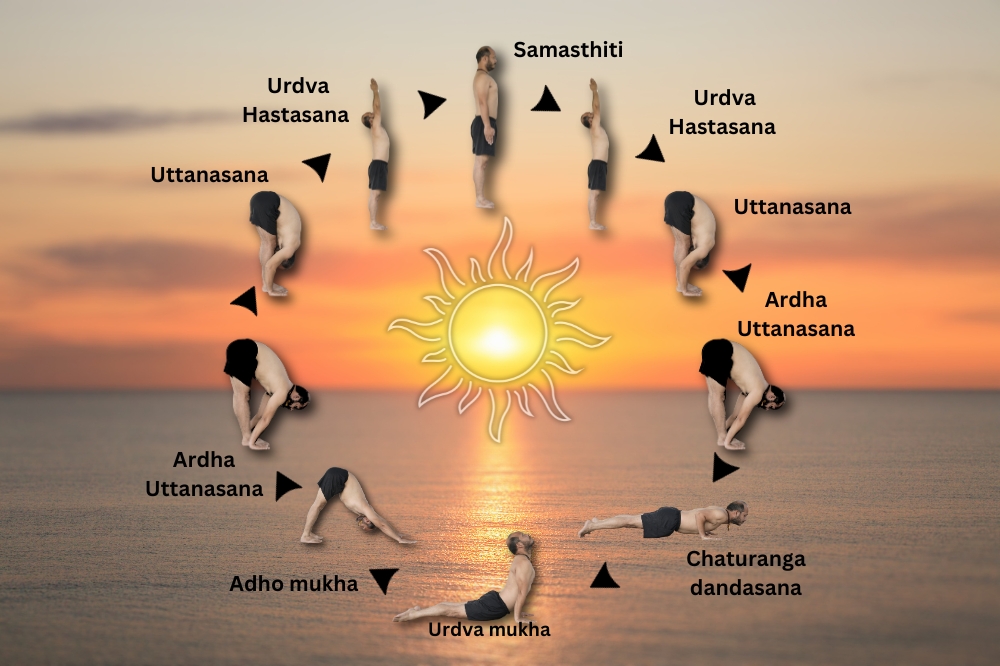
    The sun salutation sequences are a flowing series of twelve poses that are linked together with each other with breath. Let’s get to it:

    1. Mountain Pose (Tadasana):

    How to do:

    • This pose begins with standing tall with your feet.
    • Keep your hip width apart from the feet, and evenly distribute the body weight to all four corners of your feet.
    • Draw your navel in slightly while engaging your core. 
    • Stack your shoulders over your hips directly.
    • Lift your head crown and lengthen your neck.
    • Breath in and out, both deeply and evenly.

    Benefits:

    • It helps improve posture.
    • Reduce hip and back pain.
    • Strengthens core and leg muscles.
    • Regulate digestion and respiration.
    • And promotes a sense of grounding.

    2. Raised Arms Pose (Urdhva Hastasana):

    How to do:

    • Take a deep breath, inhale, and raise your arms overheated.
    • Join your hands in prayer form, reaching through your fingertips.
    • Keep your shoulder blades down and back, to your flexibility level.
    • Keep your gaze softly upwards.

    Benefits:

    • It opens the chest.
    • Increases the flexibility
    • Strengthens shoulders and arms
    • Give strength to the back muscles by lengthening the front.
    • Energises the body.

    3. Forward Fold (Uttanasana):

    How to do:

    • Inhale and hinge at your hips.
    • Fold your sleeves forward.
    • Bring your hands on top of or alongside your feet.
    • Give length to your spine as per your flexibility.
    • Relax your neck and head.
    • Let your head hang heavy for a while.

    Benefits:

    • It aids digestion.
    • It stretches the hamstrings and calves.
    • Ease, stress, tension, and fatigue.
    • Improves circulation in the body and muscles.
    • It calms the mind.

    4. Halfway Lift (Ardha Uttanasana):

    How to do:

    • Inhale and lengthen your spine.
    • Stretch your hands straight.
    • Reach to your shins or the floor.
    • Keep your face forward and bend your knee if required.

    Benefits:

    • It helps in maintaining a healthy curvature of the spine.
    • It strengthens the core and back muscles.
    • It helps prepare the body for bending postures.
    • It stretches the hamstrings.
    • Improves spinal flexibility.

    5. Plank Pose (Phalakasana):

    How to do:

    • Exhale and lower yourself to a plank position.
    • From head to heels, keep your body in a straight line and your core engaged.
    • Put your weight equally on your legs and hands. 
    • Gaze down between your hands and mind your breathing.

    Benefits:

    • Improve the posture and body balance.
    • Strengthens the core, shoulders, arms, and wrists
    • improves body flexibility.
    • Builds overall stability.
    • Removes backache.

    6. Low Plank/Knee-Chest Pose (Chaturanga Dandasana):

    How to do:

    • If you find the Plank pose challenging,
    • In this pose, you can lower your body to the mat instead of keeping it in a straight line.
    • Keep your core engaged.
    • Lengthen the spine.

    Benefits:

    • Strengthen and tone the abdominal region.
    • Relieve lower back pain.
    • Strengthen the muscles and body.
    • Provides stability.

    7. Upward-Facing Dog (Urdhva Mukha Svanasana):

    How to do:

    • Inhale and push yourself up off the mat.
    • Put your body up in an upward-facing dog pose.
    • Begin by arching your back.
    • Slowly press your chest forward.
    • Loog upward and lengthen your neck as much as possible.
    • Keep your legs strong and your core engaged.

    Benefits:

    • It stretches the body and intercostal muscles.
    • It strengthens the back, shoulders, arms, and core.
    • It helps counteract regular forward flexion activities.
    • Open the chest.
    • Improves flexibility in the spine.

    8. Downward-Facing Dog (Adho Mukha Svanasana):

    How to do:

    • Exhale and push your hips back and up (opposite of the previous pose).
    • Put your body in a downward-facing dog pose.
    • Create an inverted V shape with your body.
    • Press your heels and body on the mat to achieve the pose as closely as possible.
    • Push your chest forward and lengthen your spine.
    • Keep and maintain your gaze between your legs.

    Benefits:

    • It elongates the spine.
    • It stretches the hamstrings, calves, and shoulders.
    • It helps relieve tension and stress.
    • Strengthens the core and arms,
    • Improves circulation in the body.

    9. High Lunge (Ashwa Sanchalanasana):

    How to do:

    • Inhale and step one foot back between your hands.
    • Keep your knees to the floor and bend at a 90-degree angle.
    • Keep and maintain your hips squared and forward.
    • Keep your gaze forward and slightly upward.

    Benefits:

    • Bring stability to the body.
    • It stretches the hip flexors, quadriceps, and groyne.
    • It helps in improving joint function.
    • Strengthens the legs and core,
    • Improves balance.

    10. Halfway Lift (Ardha Uttanasana): Repeat from the other leg:

    This pose is the same as the halfway lift pose but can be done with the other leg by stepping it back between the hands. (Read number 4 pose instructions.).

    11. Forward Fold (Uttanasana): Repeat the Forward Fold:

    This pose is a replica of the forward-fold pose and can be done from a new standing position. (Read number 3 pose instructions.).

    12. Raised Arms Pose (Urdhva Hastasana): Repeat Reaching Arms Up:

    For this pose, you need to repeat the raised arm pose by keeping your arms overhead and inhaling (read number 2 pose instructions).

    13. Mountain Pose (Tadasana): Return to Starting Position:

    Exhale and return to the beginning, where we started from the mountain pose (number 1).

    This completes one round of sun salutations. You can repeat the poses with the other side as well and include this in your regular practice for improvement and warming up.

    Sun Salutations Made Easy: Modifications for New Yogis

    Sun salutations are beneficial for individuals of all levels and can be adapted by anyone. But if you are new to this practice, here are some tips to help you with better awareness and practice:

    Focus on form over perfection.

    We can achieve perfection with great practice, so it’s better to first focus on the alignment of the body correctly in each pose. It’s better to go slow and steady and adapt accordingly than push yourself and your body beyond their limits.

    Bend your knees.

    All the sequences usually require a straightened body and knees, so it is completely okay to bend your knees as many times as needed throughout the sequence practice. Poses like plank pose and downward-facing dog pose require a lot of strength, so keep your body energy neutral and bend as needed if required to maintain a proper form and protect your joints from any injury or pain.

    Utilise props

    Rather than trying one thing 100 times, try using props such as yoga blocks, which can be a great tool for all beginners. You can use them for elevating your hands for sequences like forward folds or to support you under your knees in plank pose.

    Listen to your body

    One of the most essential pieces of advice that we can give to you all reading this out there is that you should and must pay attention to the signals your body gives you. Take proper breaks whenever needed, and go slow and steady as per your convenience and health.

    Utilising and following these tips and modifications will let you enjoy the immense benefits of sun salutations at their maximum, regardless of what experience level you have.

    Conclusion

    Sun salutations are a great and fantastic way to warm up your body and begin your day. It is also effective in energising the body and relaxing it after a long day. By including this beneficial practice into your daily routine, even if you practice it a few times a week, you can experience the array of benefits it has to offer to your body, mind, and soul.

    So even though you are a beginner, don’t wait any longer; roll down your mat, and if not, you can just begin with a clean floor and give these sequences a try on your own. Be ready to be shocked and surprised by the quick benefits you will get to see in a few weeks. Make them a part of your well-being journey and guarantee the health check ahead.

    Get in Touch:
    Best Yoga Teacher Training In Bali | 100 Hour Yoga Teacher Training In Bali | 200 Hour Yoga Teacher Training In Bali