Tag: yoga school in bali

  • Surya Namaskar: A Beginner’s Guide to Sun Salutations

    Surya Namaskar: A Beginner’s Guide to Sun Salutations

    The sun salutation, also known as Surya Namaskar in Sanskrit, is a sequence of yoga poses, as determined by the name, practiced in the morning with a sun rise that links the body movement with breath. It is one of the most beautiful and best ways to warm up your body before any class while building strength and improving flexibility for better alignment. Usually, this practice is often used in the morning or before any yoga class, but you can practice it anytime as a full-body workout.

    But even if you are a beginner or a practiced yogi, practicing this requires a series of steps to be followed with focus so that you can easily enjoy the benefits of these sun salutations. In this guide, we will get you through all the poses step by step with modifications. So let’s get into the learning without wasting a second, with the multitude of benefits it offers for both body and mind.

    Benefits of Sun Salutations

    Warm-up for the body:

    Sun salutations are a great way to warm up and prepare your body for the day’s practice, yoga classes, and any physical activity. They help in moving all the muscle groups in your body gently while increasing the blood flow and loosening up all the tight areas for better practice.

    Improves flexibility and strength:

    Various poses aligned in sun salutation are usually related to stretching, which also strengthens different muscle groups throughout the body. So if you practice these poses daily, it can eventually result in improved flexibility and build up strength in the back, arms, legs, and core.

    Increases circulation:

    Practicing these salutations requires body strength, and as with any other practice, it gets your heart rate up, resulting in improved circulation throughout the body. This practice helps deliver the major nutrients and oxygen to the cells more efficiently and removes waste products from the body.

    Promotes mindfulness:

    Practicing these salutations requires focus on your breath and movements, which lead to a quiet mind and promote mindfulness. Through this, you can better start your day in a great way or de-stress your mind after a hectic day.

    Before you begin: Be Prepared

    Before you begin your movements, preparing for them is essential for an enhanced practice. While not necessary, having a yoga mat will help you with better grip and cushioning for your practice. Additionally, having comfortable clothes on will allow for better and easier movements.

    Breathe Easy:

    Sun salutations are all about synchronising your breath with your body movements, so here’s a quick tip:

    • Inhale: Fill your belly with air and breathe in through your nose as you expand your body or lengthen it (while keeping your arms up or getting back into the plank).
    • Exhale: Release all your tension as you exhale through your nose or mouth while you fold or contract your body. (Usually during a forward fold or downward-facing dog.).

    Keeping your focus on these breathing techniques will help you move your body with flexibility and fluidity while connecting it with your mind throughout the sequences.

    The Sun Salutation Sequence: Step-by-Step 

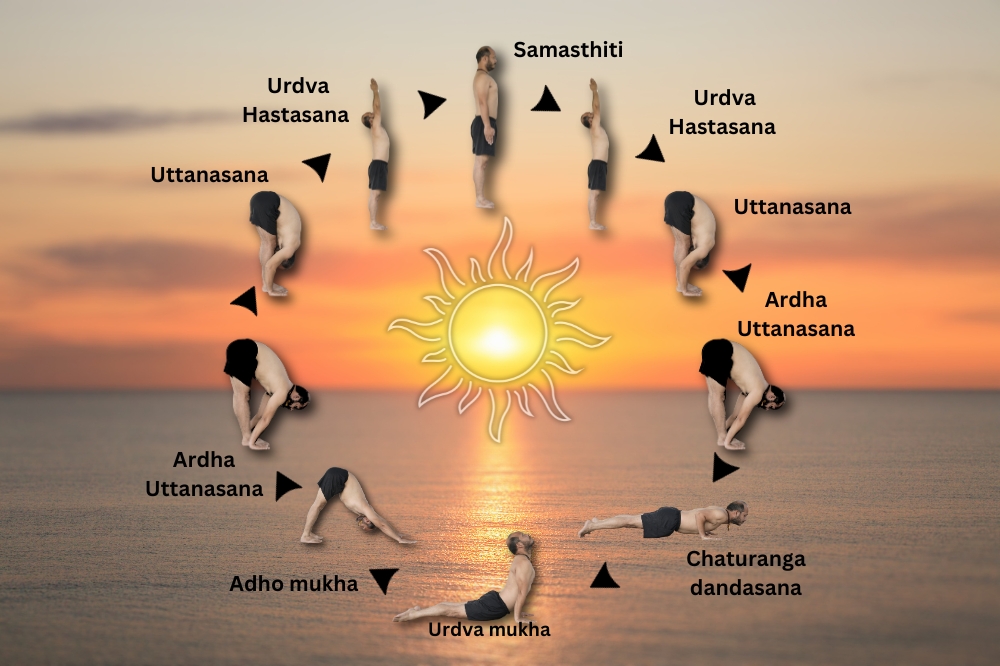
    The sun salutation sequences are a flowing series of twelve poses that are linked together with each other with breath. Let’s get to it:

    1. Mountain Pose (Tadasana):

    How to do:

    • This pose begins with standing tall with your feet.
    • Keep your hip width apart from the feet, and evenly distribute the body weight to all four corners of your feet.
    • Draw your navel in slightly while engaging your core. 
    • Stack your shoulders over your hips directly.
    • Lift your head crown and lengthen your neck.
    • Breath in and out, both deeply and evenly.

    Benefits:

    • It helps improve posture.
    • Reduce hip and back pain.
    • Strengthens core and leg muscles.
    • Regulate digestion and respiration.
    • And promotes a sense of grounding.

    2. Raised Arms Pose (Urdhva Hastasana):

    How to do:

    • Take a deep breath, inhale, and raise your arms overheated.
    • Join your hands in prayer form, reaching through your fingertips.
    • Keep your shoulder blades down and back, to your flexibility level.
    • Keep your gaze softly upwards.

    Benefits:

    • It opens the chest.
    • Increases the flexibility
    • Strengthens shoulders and arms
    • Give strength to the back muscles by lengthening the front.
    • Energises the body.

    3. Forward Fold (Uttanasana):

    How to do:

    • Inhale and hinge at your hips.
    • Fold your sleeves forward.
    • Bring your hands on top of or alongside your feet.
    • Give length to your spine as per your flexibility.
    • Relax your neck and head.
    • Let your head hang heavy for a while.

    Benefits:

    • It aids digestion.
    • It stretches the hamstrings and calves.
    • Ease, stress, tension, and fatigue.
    • Improves circulation in the body and muscles.
    • It calms the mind.

    4. Halfway Lift (Ardha Uttanasana):

    How to do:

    • Inhale and lengthen your spine.
    • Stretch your hands straight.
    • Reach to your shins or the floor.
    • Keep your face forward and bend your knee if required.

    Benefits:

    • It helps in maintaining a healthy curvature of the spine.
    • It strengthens the core and back muscles.
    • It helps prepare the body for bending postures.
    • It stretches the hamstrings.
    • Improves spinal flexibility.

    5. Plank Pose (Phalakasana):

    How to do:

    • Exhale and lower yourself to a plank position.
    • From head to heels, keep your body in a straight line and your core engaged.
    • Put your weight equally on your legs and hands. 
    • Gaze down between your hands and mind your breathing.

    Benefits:

    • Improve the posture and body balance.
    • Strengthens the core, shoulders, arms, and wrists
    • improves body flexibility.
    • Builds overall stability.
    • Removes backache.

    6. Low Plank/Knee-Chest Pose (Chaturanga Dandasana):

    How to do:

    • If you find the Plank pose challenging,
    • In this pose, you can lower your body to the mat instead of keeping it in a straight line.
    • Keep your core engaged.
    • Lengthen the spine.

    Benefits:

    • Strengthen and tone the abdominal region.
    • Relieve lower back pain.
    • Strengthen the muscles and body.
    • Provides stability.

    7. Upward-Facing Dog (Urdhva Mukha Svanasana):

    How to do:

    • Inhale and push yourself up off the mat.
    • Put your body up in an upward-facing dog pose.
    • Begin by arching your back.
    • Slowly press your chest forward.
    • Loog upward and lengthen your neck as much as possible.
    • Keep your legs strong and your core engaged.

    Benefits:

    • It stretches the body and intercostal muscles.
    • It strengthens the back, shoulders, arms, and core.
    • It helps counteract regular forward flexion activities.
    • Open the chest.
    • Improves flexibility in the spine.

    8. Downward-Facing Dog (Adho Mukha Svanasana):

    How to do:

    • Exhale and push your hips back and up (opposite of the previous pose).
    • Put your body in a downward-facing dog pose.
    • Create an inverted V shape with your body.
    • Press your heels and body on the mat to achieve the pose as closely as possible.
    • Push your chest forward and lengthen your spine.
    • Keep and maintain your gaze between your legs.

    Benefits:

    • It elongates the spine.
    • It stretches the hamstrings, calves, and shoulders.
    • It helps relieve tension and stress.
    • Strengthens the core and arms,
    • Improves circulation in the body.

    9. High Lunge (Ashwa Sanchalanasana):

    How to do:

    • Inhale and step one foot back between your hands.
    • Keep your knees to the floor and bend at a 90-degree angle.
    • Keep and maintain your hips squared and forward.
    • Keep your gaze forward and slightly upward.

    Benefits:

    • Bring stability to the body.
    • It stretches the hip flexors, quadriceps, and groyne.
    • It helps in improving joint function.
    • Strengthens the legs and core,
    • Improves balance.

    10. Halfway Lift (Ardha Uttanasana): Repeat from the other leg:

    This pose is the same as the halfway lift pose but can be done with the other leg by stepping it back between the hands. (Read number 4 pose instructions.).

    11. Forward Fold (Uttanasana): Repeat the Forward Fold:

    This pose is a replica of the forward-fold pose and can be done from a new standing position. (Read number 3 pose instructions.).

    12. Raised Arms Pose (Urdhva Hastasana): Repeat Reaching Arms Up:

    For this pose, you need to repeat the raised arm pose by keeping your arms overhead and inhaling (read number 2 pose instructions).

    13. Mountain Pose (Tadasana): Return to Starting Position:

    Exhale and return to the beginning, where we started from the mountain pose (number 1).

    This completes one round of sun salutations. You can repeat the poses with the other side as well and include this in your regular practice for improvement and warming up.

    Sun Salutations Made Easy: Modifications for New Yogis

    Sun salutations are beneficial for individuals of all levels and can be adapted by anyone. But if you are new to this practice, here are some tips to help you with better awareness and practice:

    Focus on form over perfection.

    We can achieve perfection with great practice, so it’s better to first focus on the alignment of the body correctly in each pose. It’s better to go slow and steady and adapt accordingly than push yourself and your body beyond their limits.

    Bend your knees.

    All the sequences usually require a straightened body and knees, so it is completely okay to bend your knees as many times as needed throughout the sequence practice. Poses like plank pose and downward-facing dog pose require a lot of strength, so keep your body energy neutral and bend as needed if required to maintain a proper form and protect your joints from any injury or pain.

    Utilise props

    Rather than trying one thing 100 times, try using props such as yoga blocks, which can be a great tool for all beginners. You can use them for elevating your hands for sequences like forward folds or to support you under your knees in plank pose.

    Listen to your body

    One of the most essential pieces of advice that we can give to you all reading this out there is that you should and must pay attention to the signals your body gives you. Take proper breaks whenever needed, and go slow and steady as per your convenience and health.

    Utilising and following these tips and modifications will let you enjoy the immense benefits of sun salutations at their maximum, regardless of what experience level you have.

    Conclusion

    Sun salutations are a great and fantastic way to warm up your body and begin your day. It is also effective in energising the body and relaxing it after a long day. By including this beneficial practice into your daily routine, even if you practice it a few times a week, you can experience the array of benefits it has to offer to your body, mind, and soul.

    So even though you are a beginner, don’t wait any longer; roll down your mat, and if not, you can just begin with a clean floor and give these sequences a try on your own. Be ready to be shocked and surprised by the quick benefits you will get to see in a few weeks. Make them a part of your well-being journey and guarantee the health check ahead.

    Get in Touch:
    Best Yoga Teacher Training In Bali | 100 Hour Yoga Teacher Training In Bali | 200 Hour Yoga Teacher Training In Bali
  • Understanding the 7 Chakras and Their Healing Techniques

    Understanding the 7 Chakras and Their Healing Techniques

    Have you ever paid attention to the complexity of our bodies? Well, not only in terms of flesh and bone but also in terms of energy. Our bodies consist of veritable things that are complex at their core, which makes us question their foundation. In many eastern traditions, it is believed that this energy flows through different points in our body, which are termed chakras.

    These chakras in our body, which translate to “wheels’ ‘ in Sanskrit, are like whirling vortexes. These vertices are that part of our body that governs different aspects of our spiritual, emotional, and physical well-being. Their concept has roots in ancient Hinduism and other Eastern spiritual practices, which described a network of seven chakras. Among all the seven chakras, each is believed to be associated with specific emotions, energy flows, and organs, and it is positioned along the spine and radiates outward.

    Chakras, in an ideal state, can be described as a vibrant orchestra, a perfect symphony where every musical instrument is perfectly in harmony with the rest. When our chakras are perfectly balanced, they lead to a free flow of energy throughout the body, which directly leads to:

    • Improved Physical Health: When the seven chakras are in perfect harmony, it is thought that the immune system and the digestive system become more powerful and that vital energy is also heightened. 
    • Enhanced Emotional Well-Being: According to master gland regulation, when we balance the chakras within our body, we find ourselves more emotionally balanced and strong, and we have a sense of calmness inside us. 
    • Deeper Spiritual Connection: It is believed that when the chakras are balanced, this has a positive impact on enabling one to embrace intuition, creativity, and being in tune with the purpose of life.

    When we know the workings of our chakras and understand how they are maintained in a balanced manner, the doors to a quality life open up. 

    The Seven Chakras: A Journey Through Your Energy Centres

    The transformative journey to understand chakras goes with a jump into even more core energy centers that manage and govern our overall well-being. Each chakra works differently while having a unique identity that influences specific aspects of our lives. Let’s go through each chakra one by one:

    1. Muladhara (Root Chakra)

    It is one of the seven or subtle chakras, or alternatively referred to as the physical or root chakra, and is represented by the rose with four petals.

    • Location: Coccyx, or the lowest part of the spine, which is comprised of only four small vertebrae.
    • Colour: Red
    • Associated Organs: Lumbars, legs, arches, and soles of one’s feet; adrenal glands.
    • Emotional and Spiritual Associations: A safe haven, support, a feeling of safety and protection, and good interpersonal relationships.
    • Signs of Imbalance: Students learned of fear, anxiety, feelings of insecurity, and financial insecurity.
    • Healing Techniques:

    Meditation: The best way to do this would be to concentrate on the sense of grounding or the sensation of being ‘earthed’. Imagine a red circle of light coming up from that lower chakra point. A simple phrase like “I am safe” can be good enough to help get out of this drama triangle.

    Yoga Poses: Standing Posture (Tadasana) and Fighting Postures (Virabhadrasana I and II).

    Crystals: Bloodstone, Garnet, and Black Tourmaline

    Aromatherapy: patchouli, cedarwood

    Lifestyle Practices: Exercise, walking, bicycling, healthy food and diet, and last but not least, fresh drinking water.

    2. Svadhisthana (Sacral Chakra)

    It is the Second Djemma that is believed to have been invaded by fear, most especially fear of death.

    • Location: below the navel, towards your lower abdomen.
    • Colour: Orange
    • Associated Organs: Male and female reproductive organs, urinary tracts
    • Emotional and Spiritual Associations: Insight, Sensuality, Pleasure, and Feeling
    • Signs of imbalance include a lack of sexual desire, repression of ideas, emotional issues, and problems building the intimate connection.
    • Healing Techniques:

    Meditation: Imagine an orange light around your lower abdomen at the navel base on the front side of your body. Do some creative visualisation for sensuality, joy, or positive affirmations that are associated with physical desire.

    Yoga Poses: Good preparation for the boat pose (Navasana) and dancer’s pose (Natarajasana).

    Crystals: Carnelian, known as the Stone of Creative Inspiration; Moonstone; Solarstone, the Stone of Success; and Orange Calcite, known as the Stone of Personal Power.

    Aromatherapy: Ylang Ylang, Sandalwood

    Lifestyle Practices: Awaken your sensual creativity, discover safe sexual play, and learn ways of connecting with your passion.

    3. Manipura (Solar Plexus Chakra)

    This is another main chakra that holds the third position, commonly known as the ‘naval chakra.’

    • Location: Area that is located around the beltline, or, to be precise, the solar plexus.
    • Colour: Yellow
    • Associated Organs: ceramic mounds inside the stomach; focal segmental atrophy of the liver; adrenal glands.
    • Emotional and Spiritual Associations: self-concept or employee strength, assertiveness, self-worth, determination.
    • Signs of imbalance: having low self-esteem, having a problem when it comes to decision-making, gastric-problem, and powerlessness.
    • Healing Techniques:

    Meditation: Now try to imagine that there is a clarion yellow light emanating from the centre of your belly below your breasts. Use some of your positive self-power statements and your general worth.

    Yoga Poses: God of War, Archer Pose (Vasisthasana), Boat Pose (Navasana).

    Crystals: citrine, tiger eye, and pyrite.

    Aromatherapy: Lemon, Ginger

    Lifestyle Practices: Actively sets goals and drives; performs self-care; and, most importantly, eats well.

    4. Anahata (Heart Chakra)

    Anahata is the fourth of the primary chakras, and it literally means unhurt or unbeaten.

    • Location: region of the torso, specifically the part that is situated in the middle of the body.
    • Colour: Green
    • Associated Organs: A general category that involves the heart, lungs, and immune system.
    • Emotional and Spiritual Associations: Love, care, pardon, understanding, and self-acceptance.
    • Signs of imbalance: Has problems in love and in relationships; suffers from loneliness; has anger or hatred against somebody.
    • Healing Techniques:

    Meditation: Imagine the green light coming out of your centre of spiritual awareness—the heart chakra. Repeat mantras of loving kindness and exercising positive feelings towards oneself and others.

    Yoga Poses: The Matsya Asana, the Camel Pose (Ustrasana), and the Bridge Pose (Setu Bandhasana)

    Crystals: The two emotional healing stones are rose quartz and malachite, while the two motivational stones are green aventurine.

    Aromatherapy: Rose, Geranium

    Lifestyle Practices: Professional career, time spent with family, volunteering, compliments and appreciations

    5. Vishuddha (Throat Chakra)

    Vishuddha, shivesh chakra, or vishuddhi is the fifth chakra or vortex in the yogic or tantric system of the Vedantic Hindu sect. The residing deity of this chakra is Panchamukha Shiva, five-headed and four-handed, with the shakti Shakini.

    • Location: Throat
    • Colour: Blue
    • Associated Organs: It can be the throat, thyroid gland, ears, etc.
    • Emotional and Spiritual Associations: Particularly, such abilities as communication, self-expression, truth, and creativity will be enhanced by the applicants.
    • Signs of imbalance: not being able to express yourself; not talking or speaking softly; not wanting to paint; having a sore throat
    • Healing Techniques:

    Meditation: Close your eyes, pay attention to your breathing, and try to see a blue light at the position of your throat chakra. A specific and more advanced type of mantra or affirmation could be employed to promote clear communication.

    Yoga Poses: The Plough Pose (Halasana), The Fish Pose (Matsyasana).

    Crystals: Next, the mesmerising stones are Aquamarine, Blue Lace Agate, and Turquoise.

    Aromatherapy: Chamomile, Peppermint

    Lifestyle Practices: Shout all you want to obliterate the maleficence that inhabits you; sing and dance the vile and evil out of you.

    6. Ajna (Third Eye Chakra)

    The brow, or third eye chakra, is known as Ajna and is the sixth major chakra in the body, as per Hindu mythology. It is the centre of the unconscious mind and represents Brahman, the highest supreme being.

    • Location: The brow point can be described as the eye line between both eyebrows.
    • Colour: Indigo or Purple
    • Associated organs: hypophysis cerebri, epiphysis cerebri, optic organs, encephalon
    • Emotional and Spiritual Associations: It is based on intuition, personal or accumulated wisdom, creativity, psychic capabilities, and self-identities.
    • Signs of Imbalance: Lack of confidence in deciding on instinct; inability to understand that the world is not flat; distraction; and head pain.
    • Healing Techniques:

    Meditation: May an indigo or purple light emerge from the third eye chakra. For instance, practice meditations that are directed towards visualisation and feelings in the body.

    Yoga Poses: Cats, Dogs, Child’s Pose, Downward Dog

    Crystals: amethyst, lapis lazuli, and European sodalite

    Aromatherapy: Frankincense, Lavender

    Lifestyle Practices: writing their dreams, adding a message to their journal, going for a walk or hike, and anything that helps to tap into your intuition, like doing a crossword puzzle.

    7. Sahasrara (Crown Chakra)

    The crown chakra, or Sahasrara, is often identified as the seventh primary chakra in Sanatana traditions of yoga. The chakra is violet in colour.

    • Location: top of the head
    • Colour: Violet or White
    • Associated Organs: Therefore, we have the brain and nervous system as the sporting perishables.
    • Emotional and Spiritual Associations: Awakening, Spirituality, Unity with the Self, Oneness, and Happiness
    • Signs of Imbalance: Mental State: feeling of lacking spirit, aimlessness, cynicism.
    • Healing Techniques:

    Meditation: Feel a white or violet light emanating from your head at the crown chakra region. Perform contemplations that are centred on being prepared to associate with the Divine.

    Yoga Poses: The headstand, also known as Sirsasana, is an advanced pose and should only be practiced by those with good knowledge and practice of yoga. Second, the final pose is the corpse pose, also known as Savasana.

    Crystals: combined clear quartz, amethyst, and selenite.

    Aromatherapy: Frankincense, Sandalwood

    Lifestyle Practices: prayer, acts of self-reflection, a walk in nature, a feeling of belonging, or having a reason to live.

    Keep in mind that this is a general guide, and the specific techniques that seem to stick with you might be quite different. Everyone is different, and as you start your path to chakra healing, try to see what technique works best for you.

    Conclusion

    In conclusion, our journey into the seven chakras has revealed a clear guideline for a well-rounded existence. With the help of these seven chakras, the physical health will be enriched, the states of the emotions will be optimised, and a person will have a better understanding of his spiritual self.

    But you must remember that chakra healing is not an event that only takes place one day, but more like a long process. Get ready for the investigation and discovery sessions. Don’t worry, there are a plethora of resources that can help you move forward. These include informative books, useful websites, even classes and workshops. Start today, try new approaches, and learn how your chakras can bring about positive changes to your way of life.

    Get in Touch:
    Best Yoga Teacher Training In Bali | 100 Hour Yoga Teacher Training In Bali | 200 Hour Yoga Teacher Training In Bali

  • The Yogic Diet: Understanding the Role of Nutrition in Yoga Practice and Teaching 

    The Yogic Diet: Understanding the Role of Nutrition in Yoga Practice and Teaching 

    One of the most essential things to perform or even function well in any task is energy. We should have enough energy to perform any task with full enthusiasm, and when it comes to practicing yoga, it requires an even greater amount in our body. Imagine when all the other people around you are involved in their practice without stopping; you just look at them with tiredness all over. Sounds bad, right? That’s why having a yogic diet comes into play.

    Food works as fuel for our body, and we should always keep our tank full of good fuel to run as far as we want to on our yogic path. Yogic diet plays a vital role in our yogic journey as it is an ancient dietetic philosophy that is deeply rooted in yogic principles, emphasising the connection between food, body, and mind. It shows us the consumption of healthy food that promotes our overall well-being and supports our practice.

    Understanding the yogic dietetic practice is beneficial for both practitioners and teachers. As for practitioners, including this diet plan in their practice will help enhance and improve their yoga experience by boosting their energy levels. While for yoga teachers, learning and understanding this approach will help them guide their students towards good eating habits to effortlessly complement their physical efforts on the mat.

    Ayurveda: The Pillar of Yogic Dietary Practices

    You all must have known or have gone through this word, “Ayurveda,” which is considered the ancient Indian system of holistic medicine and the foundation of the yogic diet. Ayurveda is translated as the “Science of Life,” emphasising the essentiality of having balance between your body, mind, and soul for better health. This helps in shaping the yogic diet through:

    Doshas

    According to Ayurveda, there are primarily three types of body and mind, which are called doshas (Vatta, Pitta, and Kapha). Each type of dosha has its own unique dietary needs and characteristics. While a yogic diet is a common dietary need that focuses on having Sattvic food that benefits everyone, a more personalised approach to diet based on your body dosha can be explored with Ayurveda.

    Digestive Fire (Agni)

    The digestion system is vital for every body, and in Ayurveda, we should maintain a healthy digestive fire within our body, which is also termed Agni. Thus, the yogic diet promotes various practices that support Agni, which include having regular healthy meals, avoiding any type of processed food, and consuming only those food items that are easy to digest.

    Five Elements

    Ayurveda, being a holistic practice, takes most of the things from mother nature and believes while recognising the five basic elements that are present in nature, the human body, and food itself, which include water, earth, air, ether, and fire. And having a yogic diet aims to create a subtle balance between these elements within our body, which results in a healthy body and overall well-being.

    Food as Energy: Decoding the Secret Language of the Gunas

    Have you ever thought about where this yogic diet we take gets its core principles from? No, well, it takes it from the concept of three Gunas (Sattva, Rajas, and Tamas). These are essential qualities that influence everything in this universe, which includes our food choices and the impact they have on our body and mind. Learning and understanding about these gunas is essential to navigating our yogic diet path.

    Sattva (Purity, Lightness):

    Sattva includes consuming sattvic food, which is considered light and pure and promotes mental clarity and calmness within. This food type contains fresh meals and food items such as fruits, vegetables, whole grains, and legumes. These foods are beneficial in promoting peace, focus, and healthy well-being, which are ideal for performing yogic practice.

    Rajas (Passion, Activity):

    Rajas include Rajasic foods that contain all the benefits related to stimulation, passion, and energy. This dietary potion generally includes spiced food items, meats, and some stimulants, such as coffee. These food items are known to provide a temporary burst of energy within, but later they can also lead to restlessness, anger, agitation, and distraction that can hinder and create difficulty in yoga practice.

    Tamas (inertia, heaviness):

    Tama or Tamasic food items are those that make you feel lethargic, dull, and heavy after consumption. They usually include foods with more oils and fats, such as processed foods, stale foods, and fried foods. Consumption of these foods is considered bad for health and can directly lead to sluggishness, mental fog, and negativity, which make it difficult for you to concentrate or engage in any yogic practice.

    Sattvic Foods: The Fuel for a Healthy Yoga Practice

    As we discussed above, Sattvic food, among all, takes center stage in the yogic diet for a good reason. These food items are the best and most beneficial for a healthy, energetic, and focused yoga practice. Here’s the reason to incorporate it into your diet plan:

    More Energy and Focus:

    Sattvic food items contain essential nutrients that offer you optimal energy throughout the practice. Unlike the temporary boost of energy that Rajasic food items provide, they offer a steady flow of energy that allows you to perform, focus deeply, and maintain optimal performance during the whole session.

    Clarity and Inner Peace:

    The Sattvic food diet focuses on whole-food servings that help with mental clarity and promote calmness. Through this diet plan, you can easily avoid aggression. and sluggishness, and perform the yoga practice in a state of peacefulness. This helps you approach the practice with a clear mind and an openness to experience and explore the complete benefits of yoga.

    Supports Physical Prowess:

    Physical well-being is as essential as mental clarity while performing yoga, and while this sattvic food is also rich in vitamins, antioxidants, and minerals, it healthily contributes to your physical well-being as well, which results in a more strenuous, flexible, and stamina-rich practice. This will also help you perform your yoga posture with ease.

    Core Principles of the Yogic Diet

    Ahimsa (non-violence): What not to have

    Ahimsa, which means walking on the path of non-violence, lies at the heart of the Yogic diet, which extends far beyond simply avoiding any physical harm to others. It believes in having only vegetarian food and avoiding any type of flesh item that causes harm to living creatures. Through this, you can contribute to minimising the suffering in the world and align with the Yogic philosophy of compassion and respect for every living being.

    Moderation and mindful eating: How to have

    This yogic diet principle focuses on how to have them, which includes finding the correct balance. Overconsumption, even of healthy food items, can disrupt your digestive system and create difficulty in practice. You should focus on portion control and consume only enough to nourish the body without excess. You can practice eating slowly and taking small bites while savoring them by avoiding distractions and stopping when full.

    Freshness and Seasonality: What to Have

    The Sattivic diet plan includes having fresh food items as they contain more potent sources of energy, which is beneficial in many ways as compared to processed or out-of-season food. They also maximise the nutritional content within, which provides you with a wealth of antioxidants, nutrients, and vitamins. Including them in your diet will result in good performance and contribute to more strength, stamina, and flexibility.

    Beyond the Asana: Building a Yogic Lifestyle Through Food and Practice

    Yogic dieting doesn’t only include having food in your diet and putting restrictions on it; it’s also more about following what reflects your yogic practice. Here are the benefits you will get from your practice:

    Increased energy levels

    You can incorporate foods like oats, brown rice, and quinoa, as they contain subtle amounts of carbohydrates to keep you going throughout the practice. You can also replace the refined sugar with fresh fruits like bananas, apples, and honey for quick energy. Additionally, eating healthy fat foods such as seeds, avocados, and nuts will contribute to satiety while offering slow-burning energy and preventing hunger pangs during the practice.

    Enhanced Focus and Clarity

    To enhance the overall focus and clarity of your practice, you can incorporate foods that are rich in omega-3 fatty acids, as they can boost brainpower. Also, staying hydrated throughout the day is essential for better cognitive function, for which you can take herbal teas and water. But don’t underestimate leafy greens, as they are filled with minerals, iron, and vitamin B for better focus and clarity.

    Better Strength and Flexibility

    Protein sources such as dairy products, legumes, and tofu help in building muscles and repairing tissues and support the overall strength development of yoga postures. Taking hydration lubricates your joints and allows for better motion and alignment during the yoga practice, while taking foods that are rich in vitamin C, like broccoli, is also good for collagen production as it contributes to overall good health.

    Conclusion:

    In conclusion, a healthy yogic diet is your way to be healthy, energetic, and full of positivity during your yogic practice. It is one of the most essential and powerful approaches to enhancing and improving your overall well-being and yoga practice. By following the core principles like sattvic food and practicing mindful eating, you can fill your body with clarity and subtle energy to truly flourish your mat experience.

    This approach goes beyond just eating and cultivates a holistic lifestyle built on respect for the world and other creatures, as well as your own self. Remember, it is a beautiful journey and a notable destination where you can reach and stop. It is a path you need to take and keep walking. Have, experience, experiment, and explore different food items to find the one that works best for your body type. By knowing and embracing the ancient dietetic practice, you can experience and unlock a connection and balance between your body, mind, and soul.

    Get in Touch:
    Best Yoga Teacher Training In Bali | 100 Hour Yoga Teacher Training In Bali | 200 Hour Yoga Teacher Training In Bali

  • From Beginner to Guru: What to Expect During Your Yoga Teacher Training Journey

    From Beginner to Guru: What to Expect During Your Yoga Teacher Training Journey

    We go through a series of stages of confusion and doubt before choosing anything, and when it comes to our career, it becomes essential for us to analyse and learn everything. Many of you are also thinking about choosing to be a yoga teacher, but you might be confused about the path or way from beginner to yoga guru and what you should expect from your yoga teacher training journey

    The journey from a student to a skilled yoga teacher consists of various learnings, adventures, and hard work, but it is sure to change the way of living, thinking, and working. It is a beautiful journey from a curious and raw learner stepping for the first time on the mat to a skilled and confident yoga teacher who knows how to teach as well as help others become yoga teachers and guide them in their journey too. This career path is not only about learning yoga but also about developing your personality.

    To clear all your doubts and help you make a firm decision about your career, we have curated this blog, which provides a comprehensive guide that reflects on all the essential parts of the journey from being a beginner to a skilled yoga guru. Read to learn more.

    Before you begin: Yoga teacher training requirements

    Firstly, before beginning your journey, you must know and understand the dynamics of what you will need to have before joining the course. While there is no such strict requirement for anyone to become a yoga teacher, having some basic things, such as a regular yoga practice with good physical fitness, can help you be better and will make your journey easier. 

    A consistent yoga practice will help you build a foundation and understand postures and alignments, while having good physical fitness will further enhance your learning and help you learn faster, get the most out of the programme, and avoid any potential injuries. It is a journey of self-learning, so coming with an open mind to learn all aspects will help you jump deeper into this immense pool of knowledge.

    The YTT Adventure: Yoga teacher training schedule, modules, and curriculum

    Yoga teacher training programmes are curated into two main subheads, which include intensive training programmes and part-time rams. Among which, intensive one includes a short span of time, usually a few weeks to some months, and requires complete attention from students and a full-time commitment, where they dedicate a full day to practicing.

    While a part-time YTT programmeme offers a more flexible approach to learning for all individuals with a busy and hectic schedule, it requires longer commitments of some months to a year and requires the candidate’s time over weekends or after office hours, but it takes a longer period for a student to complete this programme.

    Core Modules Covered in a Yoga Teacher Training Programme in Bali

    A YTTC covers a set of various learnings related to yoga to help you understand the basics and beginnings of this ancient practice and why it has been one of the most popular practices since ancient times.

    1. Asana (Posture) Practice and Alignment Principles:

    One of the most important teachings in YTTC is the asana practice, which is also known as the heart of yoga learning. Through your understanding of this, you can expect to:

    • Learn how to align properly for various postures, such as seated, inverted, standing, balancing, and restorative.
    • Learn to understand all the potential risks and benefits of postures that allow you to practice and teach yoga safely.
    • Explore the wide range of yoga styles, whether Hatha, Yin, Vinyasa, or any other styles, with their unique approach to practice.

    2. Pranayama (breathwork) Techniques and Benefits:

    Pranayama is a common yoga practice dating back to ancient times that includes control over our breathing. In this lesson, you can:

    • Learn and understand various breathing techniques, including kapalbhati and ujjayi.
    • Understand the technique on how to use pranayama to further enhance the yoga practice and guide the students through the same.
    • Learn about the physiological and energetic effects of this practice on the human body.

    3. Yoga Philosophy and History (including key yoga texts):

    This yoga learning includes the understanding and knowledge of intellectual teachings and the foundation of yoga, where you will likely encounter:

    • The key ancient yoga texts, such as the yoga sutras of Patanjali,.
    • The core principles of yoga and philosophy, which include the eight limbs of yoga and their ethical guidelines, are also known as Yamas and Niyamas.
    • Deep and detailed discussions over the history and evolution of yoga practice.

    4. Anatomy and Physiology for Safe and Effective Teaching:

    This learning will include the learning of the human body to offer safe yoga instructions to the students, which includes:

    • The essentiality of proper alignment during practice is to avoid any potential injury.
    • Modification of postures with respect to different bodies and limitations.
    • Learning of the musculoskeletal system that focuses on body organs such as bones and muscles and their function and importance in yoga postures.

    5. Teaching Methodology and Practice Observation:

    This includes learning how to teach effectively and efficiently, where you will learn:

    • The art of observation and implementation is where you learn from your teachers and apply that to your teachings.
    • Effective teaching techniques for better understanding and clear communication between a teacher and students.
    • The art of creating an inclusive and welcoming environment for all individuals around the world.

    6. Meditation: Quitting the mind and fostering focus

    Meditation is an ancient practice used to foster and enhance the overall focus, which will include:

    • Quitting the mind and thoughts and keeping them free to grab focus and concentration.
    • Teach techniques such as mantra meditation and mindful meditation to find peace within.
    • Use of breath to get control and divert our mind towards one goal.

    7. Ayurveda, the sister of yoga practice

    Ayurveda is the ancient Indian system that includes medicine and works as a comprehensive learning tool for yoga practice, which teaches you:

    • Understanding different doshas (body constitutions) and how they work.
    • Dietary recommendations to foster good health will make your yoga practice journey easier.
    • Self-care practices linked with Ayurveda promote a clean, healthy, and active body and mind.

    Beyond the Poses: Yoga Teacher Training Benefits and Personal Development

    Yoga teacher training is a life-changing journey, not only in the career aspect but also as an individual. Through deep and hard practice and adequate knowledge about yourself and the human body, you become a more self-aware peer, which results in a more confident, skilled, calm, and knowledgeable individual who is now ready to help others in their journey too.

    This programme lets you challenge your core areas and build your personality. It gives you the opportunity to transform yourself and grow, not just as a yoga teacher. but as an individual with a well-rounded personality and empowerment. Here are some key areas where you can see growth during your journey:

    1. A deepened yoga practice:

    A yoga teacher training course is a helpful tool to take your practice to another level. Through daily practice, you can refine your skills and explore the new variations, resulting in a deeper understanding.

    2. A sense of self-awareness:

    This practice also covers topics like yoga philosophy, which covers the understanding and learning of self, through which you will start to learn to observe everything around and inside you, which will dramatically change your way of living and thinking.

    3. Public speaking and confidence:

    One of the major areas lacking for anyone can be public speaking, but through various classes tailored to teaching techniques and with the help of constructive feedback, this course will help you master this practice and build confidence within you to lead a whole class.

    4. Building community and connection:

    YTTC brings a set of various individuals from around the world together in a class that are all passionate about yoga. Training with them, learning about their life experiences, and understanding their ways will help you create connections that last a lifetime.

    Challenges in the Journey: Yoga Teacher Training Difficulties, Overcoming Obstacles

    Achieving a goal was never easy. We have to push through all the boundaries and keep moving forward to achieve what we desire, as is the case with your YYT journey. It does come with a lot of physical and mental challenges, where the intensive and hard training will push your body while difficulty in something may create self-doubt. 

    However, you need to keep in mind that these challenges are usual, and this will open up the road to success towards your goal. All you need to do is keep moving no matter what comes to you, and in the end, you will see the results of all your hard work in your practice and personality. Here are some tips to overcome challenges during your journey:

    • Provide your body with healthy food to energise the muscles and mind.
    • Have adequate sleep and practice regularly to rectify the mistakes in postures and alignments.
    • Acknowledge your challenges, give yourself time to learn new things, and be kind to your body and mind.
    • Celebrate and embrace little achievements, and keep your mind away from negative thoughts.
    • If you’re stuck, don’t hesitate to seek support from your teachers and fellow students to help you with anything.

    The Road Ahead: Yoga Teacher Training, Certification, and Continuing Education

    When you’ve completed your YTTC, you will receive your teacher training certification, which will further open up the path for new opportunities. After which, you can enrol yourself in any course with open positions for teachers to convert your learning into practice. This task may require some proactiveness, as you can also use your connection to lend a hand as a teacher. 

    Knowledge is something that never ends, as it is like an ocean with no end. So it will be great to keep learning and gaining knowledge. Many studios, like Bali Yogshala, offer various retreats and programmes for teachers to foster their continuous education. If you have completed your 100-hour YTTC, you can also opt for the 200-hour YTTC and even the 300-hour YTTC through learning and practice to enhance your teaching skills further.

    Remember, gaining your certification is just the beginning; there is a whole life ahead, full of adventures. As you begin your journey as a yoga teacher, remember that it is a never-ending process of learning, growing, and sharing this pool of knowledge with others. Live the journey, witness the change, and guide others towards their goal too, as someone guided you towards yours.

    Conclusion:

    The yoga teacher training journey is nothing less than an adventure where you face challenges, go through them, learn from them, understand your potential, and, as a result, come out as a skilled and confident individual. This is a journey that goes far beyond just learning some postures and offers you a chance to look within, learn about yourself, and grow as a person from within and out.

    It gives you the opportunity to find your passion and ultimately become a skilled yoga teacher to help others with their journey too. So, what are you waiting for? Are you ready to change your way of life and become a yoga teacher? Choose your career path now.

    Get in Touch:
    Best Yoga Teacher Training In Bali | 100 Hour Yoga Teacher Training In Bali | 200 Hour Yoga Teacher Training In Bali